Quoting & negotiation
How to follow up on a quote: how long to wait, and what to send
By Jahangir Alam · August 22, 2026 · Updated August 23, 2026 · 10 min read
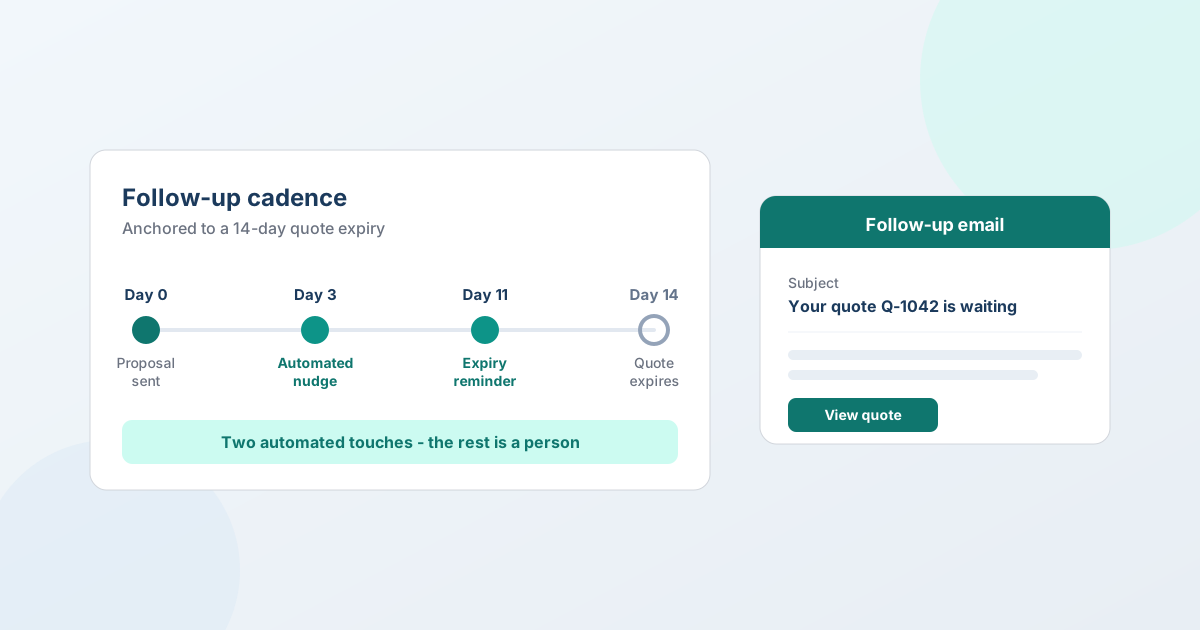
Follow up on a B2B quote against the buyer's own decision clock, not a generic drip. The quote has an expiry date, and that date is what the cadence should key off: a short nudge a few days after you send, a reminder before the offer lapses, and a human touch on anything large enough to deserve one. Two of those three can be automated. The third shouldn't be.
This guide covers how long to wait before you follow up and why that timing works, how often to chase without becoming noise, what a Shopify quote app can genuinely automate (stated precisely, because the limits matter), what has to stay human, and copy-paste follow-up email templates for each touch.
Why quote follow-up isn't sales follow-up
Generic sales cadences chase a prospect who hasn't committed to anything. A quote follow-up is different in three ways that change the timing:
- There's a deadline in the document. A quote with an expiry has a built-in reason to make contact that isn't "just checking in." The reminder is a service, not a nudge.
- Silence usually isn't disinterest. In B2B the gap between "we received your quote" and "we've decided" is often somebody else's approval queue - a purchasing manager, a finance sign-off, a budget cycle. The buyer isn't ignoring you; they're waiting on their own organization.
- The offer is priced and dated, so it can go stale. Material costs, exchange rates, and stock move. Following up isn't only about closing - it's about catching a quote that needs re-pricing before the buyer accepts something you can no longer honour.
One caution before any cadence advice, including ours: the widely-repeated figures about how many touches a deal "needs" almost all trace back to vendor blog posts with no disclosed sample or methodology. Treat them as folklore, not data - we traced the main ones. What follows is reasoning from how B2B buying actually works, and from the mechanics you have available - not from a statistic.
Anchor the cadence to the expiry date
Work backwards from when the offer lapses. A quote valid for seven days and a quote valid for sixty want completely different rhythms, and a fixed "day 3, day 7, day 14" schedule gets both wrong.
| Quote validity | First nudge | Pre-expiry reminder | After expiry |
|---|---|---|---|
| 7 days | Day 2-3 | 2 days before | Re-price and reissue |
| 14 days | Day 3-4 | 3 days before | Re-price and reissue |
| 30 days | Day 5-7 | 5-7 days before | Ask before reissuing |
| 60-90 days (custom, long lead time) | Day 7-10 | 10-14 days before | Expect a conversation, not a reissue |
Then adjust for what you know about the deal:
- Shorten when the buyer named a required-by date, when the quote is priced off something volatile, or when you're holding stock for them.
- Lengthen on a large capital purchase, a new account with an unknown approval chain, or anything a buyer told you is going to committee.
- Skip the automated nudge entirely on your biggest deals. A $200,000 quote deserves a call, and an automated email arriving in the middle of the buyer's internal review reads as though nobody is really paying attention.
What you can actually automate
This is where a lot of advice hand-waves. The precise picture in QuotWay:
One follow-up email per quote. An automation rule with the trigger a proposal goes unanswered for N days (N is 1 to 90) sends the buyer a nudge. It fires at most once per quote - not a sequence. Optional conditions can restrict it, so you can nudge only quotes under a value threshold and leave the big ones to a human. Automation rules require the Professional plan or above (how to automate quotes on Shopify covers the wider rule model).
It only fires while the buyer genuinely hasn't responded. Accepting, declining, countering, or entering an approval step all move the quote out of the waiting state, so it stops being a candidate. A counter-offer counts as a response - which is correct, and also means a countered quote that then goes quiet is your job to chase, not the automation's.
It never chases an expired quote, and it's sent by a daily sweep at a fixed, humane hour rather than at 3am.
One expiry reminder per quote, separately. That's a shop-level setting - remind the buyer N days before the quote expires (0 to 90) - and it's available from the Starter plan. Like the follow-up, it's one email, tracked per quote so a re-run never double-sends.
The two never collide. There's a 48-hour mutual mute in both directions: a buyer who just received an expiry reminder won't also get a follow-up, and vice versa.
So be clear-eyed about the ceiling: the automation gives you at most two touches - one nudge and one pre-expiry reminder. That's a deliberate floor on how much a piece of software should email someone about a price. Design your cadence around those two, and treat everything beyond them as a human decision.
There's a related design choice worth knowing: the quote's own expiry sweep never auto-expires a quote that's mid-negotiation on your side. Quotes you've received or countered but not answered are left alone, because closing them is a commercial decision, not a scheduling one.
What has to stay human
- Anything above your deal-size threshold. Set the number, exclude those quotes from the rule, and work them yourself.
- A quote the buyer countered and then went quiet on. The automation deliberately won't touch this. It's also the single highest-value follow-up you can make, because a counter means they want to buy.
- A quote that expired on a deal you still want. Reissuing at the old price without checking your costs is how you win a deal at a loss.
- The "is the spec still right?" conversation. On custom and made-to-order work, a long silence often means the requirement changed. That's a call, not an email - and on quoting custom and made-to-order products, a changed spec means re-pricing, not re-sending.
Follow-up email templates you can copy
Two of these go into the software; the rest you send yourself. A note before you copy them: QuotWay's buyer emails are name-only - they name the quote and link the buyer to the secure portal or their customer account, and never print prices in the body, because a negotiated price shouldn't be sitting in an inbox or a forwarded thread. Write your follow-ups the same way: reference the quote, don't restate the number.
1. The automated nudge (goes in the automation rule's message field; fires after N days of silence)
Just checking this reached you - your quote is ready to review whenever you are. If anything about the quantities or the delivery date has changed since you asked, reply here and we'll re-work it.
2. The pre-expiry reminder (the expiry-reminder email copy, editable in your notification settings)
A reminder that this quote is coming up to its expiry date. If you need more time, just reply - we can usually extend or reissue it. If the requirement has changed, tell us what moved and we'll re-quote.
3. Human check-in, mid-size deal (day 5-7, sent by the person who owns the account)
Hi [name] - following up on the quote we sent last week for [product/project]. No pressure on the decision; I mainly want to check whether you have everything you need for it internally. If there's a form, a spec sheet, or a lead-time confirmation that would help it through your process, I can get it to you today.
4. The approval-chain check (when you suspect it's stuck internally)
Hi [name] - is this one waiting on anyone else on your side? If it needs a sign-off, I'm happy to put together whatever your purchasing team usually needs - a formal quote document, lead times in writing, or a reference for the account.
5. The required-by-date check (when the buyer gave you a deadline)
Hi [name] - you mentioned you needed these on site by [date]. To hit that we'd want the order confirmed by around [date minus lead time]. Is that still the target, or has the schedule moved?
6. The post-expiry reopen (only when you still want the deal)
Hi [name] - the quote we sent for [product] has passed its expiry, so I didn't want to leave it hanging. If it's still live on your side I can reissue it - I'll just need to re-check current pricing and stock first. Is it worth doing?
7. The close-the-file email (the one most people never send, and should)
Hi [name] - I don't want to keep chasing something that's no longer live. Should I close this one off, or is it still in play? Either answer is genuinely useful.
That last one is worth using. An honest "we went with someone else" is more valuable than an open quote sitting in your pipeline pretending to be forecast. Your CRM says the deal is lost covers why a status that came from silence is worse than either answer.
What not to do
- Don't chase every quote at the same intensity. If a $600 reorder and a $60,000 project get the same three emails, you're overworking one and underworking the other.
- Don't follow up with nothing new to say. "Just circling back" is a message about your pipeline, not the buyer's problem. Bring something: a lead time, a spec, a deadline implication.
- Don't restate the price in the email. Negotiated pricing gets forwarded. Link to it instead.
- Don't quietly extend the expiry to avoid an awkward conversation. If your costs moved, that's the conversation.
- Don't let the automation stand in for a pipeline review. One nudge and one reminder are not a sales process. Look at your open, aging quotes every week.
Setting it up
- Decide the expiry you'll use by quote type first - the cadence hangs off it. See how long a B2B quote should be valid for setting the period, and agree the defaults with your team rather than picking a date each time.
- Turn on the expiry reminder in your notification settings and choose how many days before expiry it sends.
- Create one follow-up rule: trigger proposal unanswered for N days, and add a value condition if you want your large quotes excluded.
- Edit the two email templates so they sound like you rather than like an app.
- Put a weekly slot in the calendar to work the aging open quotes the automation deliberately doesn't touch.
FAQ
How long should you wait to follow up on a quote?
Anchor it to the quote's expiry rather than a fixed calendar. On a 14-day quote, a light nudge around day 3-4 and a reminder 3 days before expiry works well; on a 30-day quote, day 5-7 and a week before expiry. Shorten it when the buyer gave you a required-by date or the pricing is volatile, and lengthen it for large purchases going through a committee.
How do you politely follow up on a quote?
Give the buyer a reason for the message that isn't your pipeline. The quote's own expiry date is the most useful one: "this quote holds until the 14th" is a service, not a chase, and it lets the buyer act without feeling managed. Keep it short, restate the number and what it covers so nobody has to dig out the attachment, and offer a decision that isn't only yes or no - a revised quantity, a longer validity, a call if the spec has moved. Assume silence is somebody else's approval queue rather than disinterest, because in B2B it usually is, and ask whether anything is needed for their internal sign-off.
How often should you follow up on a quote?
There's no reliable published benchmark for this - the figures circulating online are mostly vendor claims without disclosed methodology. A defensible default is two automated touches (one nudge, one pre-expiry reminder) plus human contact scaled to deal size. Beyond that you're mostly signalling that you need the deal more than the buyer does.
Can you automate follow-up emails after a quote on Shopify?
Yes, with a quote app - Shopify itself has no concept of a quote to follow up on. In QuotWay an automation rule sends one follow-up email after a proposal has gone unanswered for a number of days you choose, and a separate setting sends one reminder before the quote expires. Automation rules require the Professional plan; expiry reminders are available from Starter.
Does a follow-up still send if the buyer counter-offered?
No. Countering is a response, so the quote leaves the "awaiting reply" state and stops being a candidate for the automated nudge. That's intentional - a countered quote is an active negotiation, and chasing it is a judgement call about price rather than a scheduling one. It's also usually the follow-up most worth making yourself.
What do you say in a follow-up email after a quote?
Reference the quote, give the buyer a reason to reply that isn't your pipeline, and invite the update that would change the quote - revised quantities, a moved deadline, a changed spec. Don't restate the price in the body: negotiated pricing gets forwarded, so link to the secure portal instead. Keep it short enough to answer from a phone.
What do I do when a quote expires and I still want the deal?
Ask before you reissue. An expired quote is a natural, non-pushy reason to make contact, but re-sending the old numbers without re-checking cost, stock, and exchange rates is how a deal gets won at a loss. Confirm the requirement hasn't changed, re-price, and issue a new version with a fresh expiry.
Will my buyer get two emails on the same day?
No. The follow-up and the expiry reminder mute each other for 48 hours in both directions, so a buyer who just received one won't immediately receive the other. Each is also capped at one per quote, so a rule can't re-fire on a quote it has already nudged.
Where QuotWay fits
QuotWay is a B2B quote and negotiation app for Shopify, built by EFOLI. On follow-up its job is to cover the two touches that should never depend on someone remembering: a single nudge after a proposal goes unanswered for as many days as you choose (Professional and up), and a single reminder before the quote expires (Starter and up), with a 48-hour mute so the two never stack. Both emails are editable, both are name-only with the figures behind a secure link, and every send is recorded on the quote's timeline. What it deliberately doesn't do is chase a countered quote or run a multi-step sequence - those are your calls. See automation rules, negotiation and proposals, the plans and pricing, or add QuotWay on Shopify.
Sources
- QuotWay docs: Automation rules - the When → If → Then rule model, including the follow-up trigger and its once-per-quote behaviour.
- QuotWay docs: Email notifications - reminders, follow-ups, expiry notices, and the name-only email policy.
- QuotWay docs: Proposals and versions - setting a proposal's expiry date.
- Shopify Help Center: Draft orders
Related articles
See how QuotWay handles this on your store.