Quoting & negotiation
How to absorb freight without advertising what it costs you
By Jahangir Alam · September 16, 2026 · 9 min read
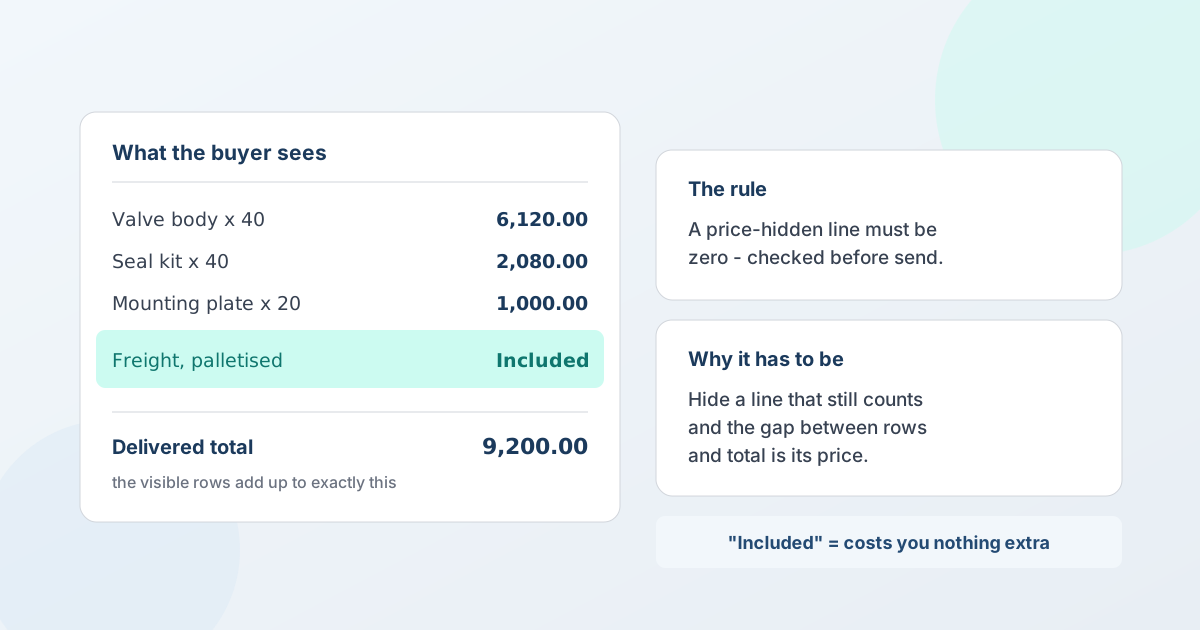
A lot of B2B is won on delivered price. The buyer isn't comparing your unit price to your competitor's unit price; they're comparing what lands on their dock for what money. So at some point you decide to eat the freight - on a consolidated order, on a first order you want badly, on an account whose volume earns it.
Then you have to put that decision on a document, and the obvious ways to do it are all slightly wrong. Delete the freight line and the quote misrepresents what the buyer is getting. Show it at $0.00 and you've invited a conversation about what else is free. Bury it silently in the unit price and you've made your own margin harder to read six months later.
This guide is about the fourth option: keep the line, show the buyer that it's included, and don't show the number - honestly, in a way that survives a buyer with a calculator.
Why absorbing freight is a pricing decision, not a discount
Freight is the part of a B2B quote most likely to be negotiated by someone who isn't looking at your costs. It's also the part you have the most control over, because you choose the carrier, the consolidation and the schedule.
That combination makes it a useful lever:
- It moves the number the buyer actually compares. Delivered price is the comparison. Taking $340 of freight off a $9,000 order reads as a better deal than taking $340 off the goods, even though it costs you the same.
- It rewards the behaviour you want. Absorbing freight on a consolidated monthly order, and not on four scattered ones, prices the convenience you're actually paying for.
- It doesn't reset your price floor. A discount on the goods is a precedent you'll be asked to repeat. Freight absorbed on a specific shipment is easier to hold as a one-off, because the reason is the shipment rather than the price.
None of which works if the quote can't express it cleanly.
The three ways it usually goes wrong
Deleting the line. The freight disappears, the total drops, and the document no longer describes the shipment. It also breaks the moment anything changes: nobody looking at that quote later can tell whether freight was quoted and absorbed, or simply forgotten.
Showing $0.00. Technically accurate, but a zero in a price column is an invitation. It reads as a list price of nothing rather than a concession you made, and it sets up the next conversation - if freight is free here, why is it $290 on the next one?
Folding it into the unit price without saying so. This is legitimate pricing, and sometimes the right answer. The failure is not telling yourself: three months later the line reads as a unit price, your margin analysis treats it as one, and the freight you absorbed is invisible in your own numbers.
The fourth option keeps the line, keeps the record, and shows the buyer a word instead of a figure.
"Included" - the line stays, the number doesn't
Set a quote line's buyer visibility to price hidden and the buyer sees "Included" where the amount would be. The line still appears - on the quote, in their Shopify customer account, in the buyer portal, and on every PDF - so the shipment is still described. Only the figure is withheld.
That's the useful shape for absorbed freight. The buyer can see that delivery is part of what they're getting, without a number that becomes the subject of the next round. Per-line buyer visibility is available on the Professional plan and above; see show a line without showing its price for the setup.
The rule that makes it honest: the line must be zero
Here is the constraint, and it is the whole reason to trust the feature: a price-hidden line must be 0.00. A proposal with a hidden line at a non-zero price won't send.
That sounds like a limitation until you work out what the alternative would do. Buyer-facing totals come from the stored quote figure, not from adding up the rows on the screen. So if a $340 freight line were priced at $340 and merely had its number omitted, the buyer would see a total $340 higher than the visible lines add up to - and the difference is the hidden price. Anyone can do that subtraction. You'd have built a puzzle, not a concession. (Why we never sum a total from the rows we render is the engineering version of the same argument.)
So the honest reading of "Included" is narrow and exact: this costs you nothing extra. It cannot mean we're not telling you what this costs, because a line that moves a visible total isn't hidden - it's obfuscated, and buyers are good at arithmetic.
Which gives you a clean rule for which tool to reach for:
- You're absorbing the cost - the buyer pays nothing extra for it. Use a price-hidden line at zero, showing "Included".
- The buyer is paying for it, you just don't want it itemised - fold the amount into a visible line and price that line accordingly. Don't call it included.
The two are different commercial positions, and the software refuses to let you blur them. That refusal is what makes the first one credible.
What the buyer sees, surface by surface
Consistency matters here more than usual, because a freight line that says "Included" on the quote and shows a number on the PDF would undo the whole thing. The line reads the same way everywhere:
- The quote and their customer account - the item, with "Included" in place of the amount
- The hosted buyer portal - the same
- Proposal, Confirmation and Pro-Forma PDFs - the same, and the totals are unaffected, because the line is zero
- The Shopify draft order at conversion - the line converts at zero, so the shipment is itemised on the order the buyer receives
That last one is worth noticing. The freight line survives into Shopify rather than evaporating at conversion, so your fulfilment team can see that the shipment was quoted with delivery included.
When you should show the number instead
Hiding freight is a tool, not a default. There are cases where the figure is doing work for you:
- When you want consolidation. If four separate shipments cost $290 each and one consolidated shipment costs $340, showing both numbers is the argument. Hide it and the buyer has no reason to change their ordering pattern.
- When freight is genuinely volatile. On oversized or international shipments, a visible quoted freight amount with a clear validity date protects you. "Included" on something you haven't locked down is a promise you may not be able to keep - see shipping and freight on B2B quotes for pending versus locked rates and live carrier rates, which are available from Starter.
- When the buyer arranges their own carrier. If they're collecting or using their own freight account, the line should say so rather than imply you're covering something.
The useful question isn't "should freight be visible?" but "is this number persuading the buyer, or just giving them something to negotiate?"
A worked example
A distributor quotes a $9,200 order across eleven lines. Palletised freight to the buyer's depot comes to $340.
They could take $340 off the goods, which sets a unit-price precedent they'll be asked to repeat. Instead they keep every unit price intact, add the freight line, set it to zero, and mark it price hidden. The buyer's quote shows ten priced lines and one that reads Freight, palletised - Included. The total is $9,200, which is exactly what the visible lines add up to.
Three things follow. The buyer compares a delivered price of $9,200 against a competitor who quoted $9,050 plus freight, and wins on arithmetic they can do themselves. The unit prices stay where they were, so the next order starts from the same place. And the quote still says freight was part of the deal, so when the same buyer asks for the same terms on a smaller order, the record shows what was actually agreed and why.
Common mistakes
- Marking a line "Included" while it carries a price. The proposal won't send, which is the guard working. Set it to zero or make the price visible.
- Absorbing freight without recording that you did. If the line disappears, your own margin analysis can't see the cost you took on.
- Hiding freight on a rate you haven't locked. "Included" is a commitment. Lock the rate, or quote it visibly with an expiry.
- Using a hidden line to disguise a price the buyer is actually paying. That's the case the zero rule exists to prevent, and the buyer will find it with one subtraction.
- Applying it to everything. If most lines read "Included", the quote stops communicating. Reserve it for what you're genuinely absorbing.
FAQ
Can I hide the shipping cost on a quote?
Yes, on Professional and above, if you're absorbing it. Set the freight line's buyer visibility to price hidden and the buyer sees "Included" instead of an amount, on the quote, in their customer account, in the portal and on every PDF. The line must be priced at zero - hiding a figure the buyer is still paying would leave a gap between the visible lines and the total that reveals the number by subtraction.
How do I offer free shipping on a B2B quote?
Add the freight as its own line, price it at zero, and set it to price hidden so it reads "Included". That keeps the shipment described on the document without putting a zero in the price column, and the line converts onto the Shopify draft order so fulfilment can see delivery was part of the deal.
Why must a price-hidden line be zero?
Because buyer-facing totals come from the stored quote figure rather than being summed from the rows on screen. If a hidden line carried a real price, the difference between the visible lines and the printed total would be exactly that price. The zero rule is what makes "Included" an honest statement rather than a puzzle.
Should I absorb freight or discount the goods?
It depends what precedent you want. A discount on the goods resets the unit price you'll be asked to match next time; freight absorbed on a specific shipment is easier to hold as a one-off, because the justification is the shipment rather than the price. Absorbing freight also moves the delivered price, which is usually the number the buyer is comparing.
Does the hidden freight line still reach the Shopify order?
Yes. The line converts onto the native Shopify draft order at zero, so the shipment is itemised on the order the buyer receives and your fulfilment team can see it was quoted with delivery included.
Which plan do I need?
Per-line buyer visibility - the setting that produces "Included" - is on the Professional plan and above. Adding a freight line to a quote, pricing it, and converting the accepted quote to a Shopify draft order work on every plan, including the free Lite plan. Live carrier rates are available from Starter. See pricing.
Where QuotWay fits
QuotWay is a B2B quote and negotiation app for Shopify, built by EFOLI. On freight specifically: you can add shipping as a line and price it, pull live carrier rates from Starter, set any line to price hidden so the buyer reads "Included" from Professional, and convert the accepted quote to a native Shopify draft order with the line intact. The zero rule is enforced at send rather than explained in a tooltip, which is the difference between a privacy feature and a trick. See negotiation and proposals, show a line without showing its price, the plans and pricing, or add QuotWay on Shopify.
Related articles
See how QuotWay handles this on your store.