B2B strategy
Shopify Wholesale Channel is gone: what to use for wholesale in 2026
By Jahangir Alam · August 20, 2026 · Updated August 22, 2026 · 11 min read
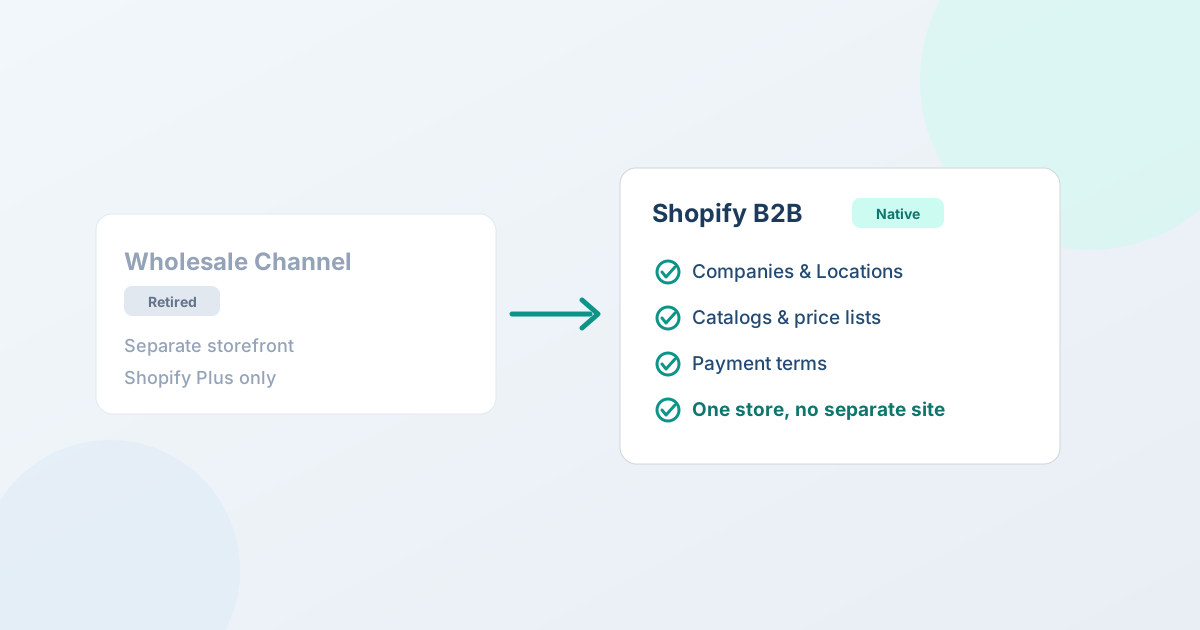
If you've run wholesale on Shopify for a while, you remember the Wholesale Channel - the separate, password-protected wholesale storefront that let Shopify Plus merchants show trade prices to approved buyers. It's gone, replaced by Shopify's native B2B functionality built directly into your store and checkout. If you're on the old channel, migrating off it, or just researching how to sell wholesale on Shopify in 2026, this guide explains what changed, what replaced it, and exactly what to use now for standing wholesale, negotiated deals, and everything in between.
What the Shopify Wholesale Channel was
The Wholesale Channel was a Shopify Plus feature: a separate wholesale storefront, usually on its own subdomain, that sat alongside your main retail store. You'd invite approved wholesale customers, log them in behind a password, and show them a wholesale-only catalog with trade pricing - discounts off retail, volume breaks, and minimums - kept entirely apart from the public store.
For its time it solved a real problem: it gave wholesale buyers a private, priced place to order without exposing trade pricing to retail shoppers. But the design had a cost. It was a second storefront to maintain - a parallel catalog, separate theming, its own quirks - bolted onto your retail store rather than integrated with it. Wholesale customers lived in a place that felt separate from the rest of your Shopify data, and the whole thing was locked to the Plus plan. As B2B selling on Shopify grew up, that "separate storefront" model started to feel like the wrong shape.
What happened to it - and why
Shopify moved wholesale out of a bolt-on channel and into the platform itself. Rather than a separate storefront, wholesale is now handled by native B2B functionality: Companies (the buying organizations), catalogs and price lists (their specific pricing), and payment terms - all built into your existing online store and checkout. The standalone Wholesale Channel was retired in favor of that native model.
The reasoning is sound. A separate storefront meant duplicated catalogs, split data, and extra maintenance; native B2B means one store, one catalog, one checkout, serving both retail shoppers and business accounts, with each buyer seeing the right prices and terms based on who they are. It's more integrated, less to maintain, and - crucially - no longer locked behind Plus (more on that below). The direction of travel is clear: Shopify wants B2B to be a first-class part of every store, not a separate room off to the side.
What replaced it: native Shopify B2B
Native Shopify B2B is the successor, and it maps the old channel's jobs onto a better model:
- Companies, Locations, and contacts. Instead of a list of invited wholesale customers, you have Companies - the organizations you sell to, each with one or more Locations and the contacts authorized to buy. Pricing, tax treatment, and terms attach to the company, so a buyer's whole relationship travels with them when they log in.
- Catalogs and price lists. The wholesale catalog and trade pricing become a catalog (a product selection plus a price list) assigned to a company or location - fixed prices or a percentage off retail, with quantity rules. No duplicate SKUs, no separate storefront. See Shopify B2B catalogs and company-specific pricing.
- Payment terms. The invoicing that wholesale buyers expect - Net 30, Net 60, due on fulfilment - is native, assigned to the company. See Shopify B2B payment terms.
- Draft orders. B2B orders are created as draft orders with the agreed prices and terms, then invoiced - which is also how a negotiated deal becomes an order.
For the full breakdown, see Shopify B2B features explained.
Wholesale Channel vs native Shopify B2B, side by side
If you ran the old channel, here's how the two models compare on the dimensions that matter:
- Storefront. Wholesale Channel: a separate, password-protected storefront to maintain. Native B2B: your one existing store, with buyers seeing company pricing when they log in.
- Catalog. Wholesale Channel: a parallel wholesale catalog. Native B2B: one catalog with per-company price lists - no duplicate SKUs, no split inventory.
- Customers. Wholesale Channel: a list of invited wholesale customers. Native B2B: Companies with Locations and contacts, so pricing, tax, and terms attach to the organization and travel with the buyer.
- Payment. Wholesale Channel: order and pay. Native B2B: payment terms (Net 30, Net 60, due on fulfilment) built in.
- Plan. Wholesale Channel: Shopify Plus stores only. Native B2B: capability-based, available beyond Plus on stores with B2B enabled.
- Negotiation. Neither the old channel nor native B2B negotiates - both show fixed prices. That gap is filled by a quote app in either era.
The through-line is consolidation: the old model bolted a second store onto your first, and the new one folds wholesale into the store you already run. Less to maintain, one source of truth, and pricing that follows the buyer instead of living in a separate room.
The three ways to run wholesale on Shopify now
With the channel gone, wholesale in 2026 runs one of three ways - and most stores use more than one:
- Native Shopify B2B, for standing accounts. Companies you've onboarded with an assigned catalog, price list, and payment terms order at their agreed prices and pay on terms - largely self-serve. This is the direct successor to the Wholesale Channel for published, account-specific pricing.
- A quote app, for request-a-quote and negotiated wholesale. Native B2B handles published pricing, but a lot of wholesale is a conversation: a buyer requests a price, you negotiate, you agree. For that, you add a quote workflow - a "Request a quote" button, versioned proposals and counter-offers, and one-click conversion to a Shopify order. See B2B quotes on Shopify.
- Tag- and segment-based wholesale, for stores without native B2B. If you're not set up with Companies, you can still run wholesale with customer tags and segments: hide prices from the public, show approved buyers trade pricing or a "Request a quote" path, and gate the storefront by who's logged in. This works on any Shopify plan, native B2B or not. See how to sell wholesale on Shopify.
Most wholesale operations combine the first two: native B2B for standing accounts on published prices, a quote app for the negotiated and request-a-quote deals a price list can't cover.
Migrating from the Wholesale Channel
If you're moving off the old channel, the transition is mostly a re-mapping exercise. A practical order of operations:
- Recreate your buyers as Companies. Each wholesale customer becomes a Company with its Locations and contacts. This is the foundation everything else attaches to.
- Rebuild wholesale pricing as catalogs and price lists. Your wholesale catalog and trade prices move into a catalog assigned to each company - fixed prices or a percentage off retail, with quantity rules where you need minimums or case quantities. No duplicate wholesale SKUs.
- Assign payment terms. Set each company's terms (Net 30 and so on) so their orders are invoiced the way they expect.
- Add a quote workflow for the negotiated side. The old channel showed fixed prices; if any of your wholesale is negotiated, request-a-quote, or one-off volume, add a quote app so those deals have a home instead of falling back to email.
- Retire the separate storefront. Once companies are set up, buyers order through your main store in their company context - there's no second storefront to maintain.
Moving the buyers and their order history into Companies has its own rules - two paths, only one of which has an API. Migrating wholesale customers to Shopify Companies is the step-by-step version for whoever scopes the job.
The upshot of migrating is usually less to run, not more: one store instead of two, one catalog with per-company pricing instead of a duplicated wholesale catalog, and negotiation handled properly instead of in email.
What you gain in the move - and the one thing that doesn't change
Moving from the Wholesale Channel to native B2B is mostly upside: one store instead of two, one catalog with per-company pricing instead of a duplicated wholesale catalog, native payment terms, and no Plus requirement. Your wholesale buyers get a cleaner experience too - they shop your real store in their company context rather than a separate, often dated, wholesale site.
The one thing that doesn't change is the part native B2B was never meant to solve: the price conversation. The Wholesale Channel showed fixed prices; native B2B shows fixed prices; both assume the number is already known. If your wholesale involves requesting a price, negotiating volume, or quoting a buyer before they're set up as a company, that was true in the old channel and it's true now - you need a quote layer on top. The migration is a good moment to add it, because it's the piece neither Shopify model provides on its own.
Do you need Shopify Plus for wholesale now?
No - and this is one of the biggest changes from the Wholesale Channel era. The old channel was Plus-only. Native Shopify B2B is capability-based: since the 2026 rollout, Companies, catalogs, and payment terms extend to Basic, Grow, and Advanced stores with B2B enabled, not just Plus. And a large amount of wholesale selling - gated prices, a request-a-quote flow, tag- and segment-based pricing, a hosted buyer portal - needs no native B2B at all and works on any Shopify plan through a quote app. So "wholesale requires Shopify Plus" is outdated advice; check whether B2B is available on your store, and remember you can quote wholesale buyers without it. What Plus still buys you - unlimited catalogs, per-company catalog assignment, deposits - is covered plan by plan in do you need Shopify Plus for B2B?.
Where a quote app fits in the new model
Native B2B replaced the Wholesale Channel for published wholesale pricing, but it deliberately doesn't do the price conversation: requesting a quote, negotiating with counter-offers, routing approvals, accepting part of a deal, or quoting a buyer who isn't set up as a Company yet. Those are quoting features, and they're the layer a quote app adds on top of native B2B.
QuotWay is that layer: a "Request a quote" button and hide price, versioned proposals and two-way counter-offers, approval workflows, and one-click conversion to a native Shopify draft order with the buyer's payment terms applied. It reads your real Shopify products, customers, and Companies, and writes accepted quotes back as native orders - so it complements native B2B rather than replacing it, and it works for tag-based wholesale on non-Plus stores too. See Shopify B2B quoting and the wholesale and distribution solution.
Common mistakes in the transition
- Assuming you need Shopify Plus. The Wholesale Channel was Plus-only; native B2B isn't. Check your store's B2B capability instead of upgrading by reflex.
- Recreating a separate wholesale storefront. The whole point of native B2B is one store with per-company pricing. Don't rebuild the thing Shopify retired.
- Leaving negotiation in email. Native B2B handles published prices; if your wholesale involves any back-and-forth, add a quote app so those deals don't fall through the cracks.
- Duplicating SKUs for wholesale prices. Price lives in the catalog now, so one product carries per-company prices - no "wholesale" duplicate that splits your inventory.
FAQ
Is the Shopify Wholesale Channel still available?
No. Shopify's standalone Wholesale Channel - the separate, password-protected wholesale storefront that was a Plus feature - has been retired in favor of native Shopify B2B, which builds Companies, catalogs, price lists, and payment terms directly into your existing store and checkout.
What replaced the Shopify Wholesale Channel?
Native Shopify B2B. Instead of a separate storefront, wholesale is handled by Companies (the buying organizations), catalogs and price lists (their pricing), and payment terms - all inside your main store and checkout. For negotiated and request-a-quote wholesale, you add a quote app on top; for stores without native B2B, tag- and segment-based wholesale still works on any plan.
How do I sell wholesale on Shopify in 2026?
Three ways, often combined: use native Shopify B2B (Companies and price lists) for standing accounts on published pricing; add a quote app for request-a-quote and negotiated deals; and use customer tags and segments with hidden prices for wholesale on stores that don't run native B2B. You no longer need a separate wholesale storefront.
Do I need Shopify Plus for wholesale now?
No. The old Wholesale Channel was Plus-only, but native Shopify B2B is capability-based since the 2026 rollout, so stores beyond Plus with B2B enabled can use Companies, catalogs, and payment terms. Tag- and segment-based wholesale and request-a-quote flows work on any plan without native B2B at all.
How do I migrate from the Wholesale Channel to native B2B?
Recreate your wholesale buyers as Companies with Locations and contacts, rebuild your wholesale pricing as catalogs and price lists assigned to those companies (no duplicate SKUs), assign payment terms, add a quote workflow for any negotiated wholesale, and retire the separate storefront. Buyers then order through your main store in their company context.
Can I still show wholesale-only prices to approved buyers?
Yes. With native B2B, a company's catalog and price list show that buyer their own pricing when they log in. Without native B2B, you can hide public prices and reveal trade pricing (or a "Request a quote" button) to approved buyers by customer tag or segment. Either way, retail shoppers don't see wholesale pricing.
Can I keep using a separate wholesale storefront?
You can technically build a separate storefront, but native Shopify B2B removes the need for one: your wholesale buyers shop your main store in their company context, seeing their own catalog and prices, while retail shoppers see retail. Most merchants consolidate onto the single store when they move off the Wholesale Channel, because a second storefront means a duplicated catalog and extra maintenance for no real benefit. The whole direction of native B2B is one store serving both audiences.
What's the difference between the Wholesale Channel and a wholesale app?
The Wholesale Channel was Shopify's own feature - a separate wholesale storefront on Plus, now retired. A wholesale or quote app is third-party software that adds capabilities Shopify's native tools don't: a request-a-quote button, structured negotiation with counter-offers, approvals, and hide-price targeting by customer or segment. With the channel gone, native Shopify B2B covers standing wholesale pricing, and an app adds the price conversation on top - they're complementary layers, not the same thing.
Where QuotWay fits
QuotWay is a B2B quote and negotiation app for Shopify, built by EFOLI, that adds the wholesale layer native B2B doesn't have: a "Request a quote" button and hide price, versioned proposals and counter-offers, approvals, and one-click conversion to a native Shopify draft order with payment terms. It works with native Shopify B2B for negotiated deals, and on its own for tag- and segment-based wholesale on any plan - so whether you're migrating off the Wholesale Channel or building wholesale fresh, it covers the price conversation a catalog can't. The free Lite plan runs the full quote → negotiate → draft-order loop; see the wholesale and distribution solution, Shopify B2B quoting, the plans and pricing, or add QuotWay on Shopify.
Sources
Related articles
See how QuotWay handles this on your store.