Quoting & negotiation
Quote-to-order: how an agreed quote becomes a real order
By Jahangir Alam · August 28, 2026 · Updated October 7, 2026 · 12 min read
- Last verified
- Shopify API
- 2026-10
- Audience
- Sales and operations teams running a quote-to-order process, on Shopify or anywhere
- Scope
- The quote-to-order process end to end and its Shopify implementation at API 2026-10: what carries and what recalculates at conversion, approvals before conversion, the 500/499 line-item ceiling, and how the stages are measured
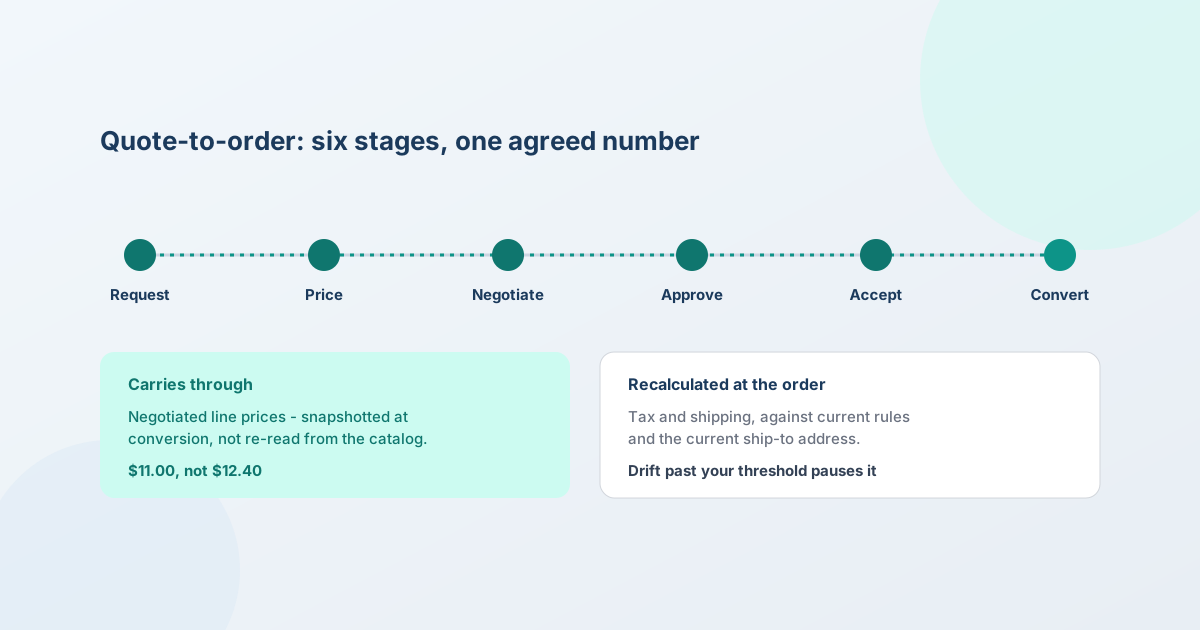
Quote-to-order is the process of turning an agreed quote into a real, fulfillable order without re-entering it - request, price, negotiate, approve, accept, convert. It's the stretch of B2B selling between "here's our price" and "we have an order", and it's where agreed numbers most often go missing.
Half the confusion around it is vocabulary, so this guide starts there, then walks the stages, the places the process actually breaks, what it looks like on Shopify, and how to measure whether yours is working.
Quote-to-order, quote-to-cash, order-to-cash, CPQ
Four terms, heavily overlapping, routinely swapped in conversation and in software marketing. (The first is written both ways - quote-to-order and quote to order - which doesn't help.) They cover different spans:
| Term | Starts at | Ends at | Usually owned by |
|---|---|---|---|
| CPQ (configure, price, quote) | A buyer's requirement | A quote going out | Sales |
| Quote-to-order | A quote request | A confirmed order | Sales and operations |
| Order-to-cash | An order | Cash collected | Operations and finance |
| Quote-to-cash | A quote request | Cash collected | The whole commercial chain |
Two things follow. CPQ stops where quote-to-order gets interesting - it's concerned with producing a correct quote, not with what happens to the agreement afterwards. And quote-to-cash is quote-to-order plus order-to-cash, which is why software sold as "quote-to-cash" is usually either a quoting tool with invoicing bolted on or an ERP with quoting bolted on.
If you're evaluating tools, the useful question isn't which label they use. It's where their span starts and stops, and whether the handover at each boundary is automatic or a human retyping something.
The stages, and what has to survive each one
A quote-to-order process has six stages. What matters at each is not just what happens, but what has to carry forward intact.
| Stage | What happens | What must survive |
|---|---|---|
| Request | A buyer asks for a price on specific items and quantities | The requirement: products, quantities, spec, delivery destination, required-by date |
| Price | You build a priced proposal | Line prices, discounts, shipping, expiry - as a record, not a message |
| Negotiate | Both sides counter until terms are agreed | Every round, with what changed - so "what we agreed" is never in dispute |
| Approve | Internal sign-off where the deal warrants it | Who approved, when, and on what basis |
| Accept | The buyer commits | The exact version accepted, and who accepted it |
| Convert | The agreement becomes an order | The agreed prices, terms, and any PO reference |
Read down the right-hand column and the through-line is obvious: every stage is a chance to lose the agreed number. A process that's working is one where the price on the order is provably the price both sides agreed, and you can show how it got there.
Where quote-to-order actually breaks
In practice the failures are consistent across businesses:
- Re-keying into a second system. The commonest and most expensive. Someone reads an accepted quote and types it into an order. A transposed digit becomes a margin problem nobody notices until month end.
- Prices drifting between agreement and order. The quote said one thing; the order was built from today's catalog. This is re-keying's quieter cousin, and it's worse because it looks correct.
- Approvals living in email. A manager replies "fine by me" in a thread. Six months later, nobody can answer who authorised a 22% discount.
- Terms agreed but not applied. You agreed Net 30 during the negotiation and the order goes out demanding payment at checkout - or worse, the buyer's finance team receives something their process can't pay.
- Partial acceptance treated as a new deal. The buyer wants eight of eleven lines. If your process can't convert eight and keep three open, you either lose the three or delay the eight.
- No audit trail. The version, the approver, the acceptance and the conversion each live somewhere different. When someone asks how a price was reached, reconstructing it takes an afternoon.
Notice that none of these are pricing problems. They're handover problems - a fact known at one stage that fails to reach the next. The narrower, technical list - what Shopify itself recalculates between an accepted quote and its draft order, and how a conversion survives it - is in what breaks between quote time and conversion time.
Quote-to-order on Shopify
Shopify has no native quote object. Its model starts at the cart or the order, so the request-price-negotiate-approve-accept stages have no home in the platform, and the last stage has an obvious one: a Shopify draft order.
That makes the shape of a B2B quote to order process on Shopify fairly clear. Handle the quote lifecycle in a quote app, then convert the accepted quote into a native draft order - so the resulting order sits where the rest of the business already is. Your reports, taxes, fulfilment, apps and accounting see an ordinary Shopify order, because that's what it is.
The alternative - a quoting tool that keeps orders in its own system - reintroduces exactly the handover problem the process exists to remove.
The mechanics of that conversion, and what a draft order can and can't do, are covered in Shopify draft orders for B2B; the states a quote needs before the draft order exists, and why the draft order cannot hold them, are set out in a Shopify draft order is not a quote. The rest of this guide stays on the process.
What carries, and what recalculates
This is the part most quote-to-order writing skips, and it's the part that decides whether the number on the order matches the number you agreed.
Negotiated line prices carry. They're snapshotted at conversion rather than re-read from your catalog. That's the whole point: a price agreed three weeks ago survives a catalog change made last Tuesday.
Tax and shipping recalculate. Shopify recomputes both when the draft order is created, against current rules and the current ship-to address. It has to - tax is a legal calculation that depends on where the goods are going, and the address may have changed since you quoted.
Which means the two can disagree, and a process that ignores that is a process that surprises someone. The sane handling is to compare the quoted figures against the recalculated ones and stop if the gap is material. In QuotWay, any difference is recorded on the quote's timeline; tax drift past a threshold you set (2% by default) requires explicit acknowledgement before the order goes out, and an automated conversion halts for a human. Shipping drift is surfaced for review without blocking.
The most common cause of an unexpected gap isn't a rule change. It's the ship-to address changing between the proposal and the conversion - which is fixable by checking the address rather than adjusting a threshold.
The cases that break a naive process
A quote-to-order process that only handles "buyer accepts everything, one order comes out" will meet all of these within a quarter:
Partial acceptance. The buyer commits to the lines they're ready for and keeps negotiating the rest. Converting the accepted lines immediately closes the deal you can win today instead of holding it hostage to the rest. (Partial order acceptance.) Professional plan and up.
One quote, several orders. Different delivery addresses, staged shipments, or separate warehouses. Splitting an accepted quote into several draft orders means each order matches how it actually ships - and each group reconciles its own shipping, so convert together if the buyer expects one freight charge.
Lines that aren't products. An assembly fee, freight, a made-to-order item. A custom line carries a title and a price with no variant behind it and converts onto the order as a custom line item. (Custom and manual line items.)
Money up front. A deposit taken at checkout with the balance on terms - "50% down, balance Net 30". On Shopify that's a Plus-only capability, from the Professional plan on our side.
Payment terms. The Shopify payment terms set on the quote - Net 30, due on receipt, due on fulfilment - are applied when it converts, so a negotiated deal is invoiced rather than charged. (Shopify B2B payment terms.) That works on any quote, on every plan, and doesn't need Shopify B2B.
One platform limit worth designing around: a Shopify draft order holds up to 500 line items, and the Admin GraphQL draftOrderCreate and draftOrderUpdate mutations accept 499, so an app should treat 499 as the practical ceiling (the draft-order limits post has the sources; corrected from an earlier "200" on 22 September 2026). If your buyers regularly order hundreds of distinct SKUs in one go, plan for splitting.
Approvals belong before conversion, not after
A recurring design mistake is to put sign-off at the end - approve the order once it exists. That's too late twice over: the buyer has already seen a price you hadn't authorised, and unwinding an order is far worse than not sending a proposal.
Approval belongs at the two points where a commitment is made to someone outside the business: when a proposal is sent, and when the buyer accepts. Gate the first and a rep can't put an unauthorised price in front of a buyer at all. Gate the second and the buyer's own organisation can run its procurement sign-off before committing.
For that to be a control rather than a convention, the check has to be enforced server-side rather than shown in an interface - see how approval enforcement works - and the thresholds have to be written down before they're configured, which is what an approval matrix is for.
Measuring quote-to-order
Two numbers, and one caution.
Quote-to-order conversion rate - the share of quotes that become orders. Before comparing it to anything, decide the denominator: requests received, proposals sent, or quotes that reached a decision. The same business in the same month can honestly report figures ranging from about 30% to over 60% depending on which you pick.
Cycle time - how long from request to order. Worth splitting into first response, proposal response, and total, because a business that acknowledges in an hour and quotes in three days has a very different problem from one that does neither.
The caution: there is no credible published benchmark for either. The figures circulating come from vendor pages with no disclosed sample or methodology, and the rigorous research in this area measures lead response rather than quote response. What the published B2B quote benchmarks actually say traces each one. Compare your rate to your own trend on a fixed definition, not to a number you found.
A worked example
A distributor receives a request for 2,400 units of a part at an annual-contract price.
- Request. The buyer submits from the storefront with quantity, delivery destination and a required-by date six weeks out. Catalog price is $12.40, so the request estimates at $29,760.
- Price. A rep builds a proposal at $11.20 a unit - a 9.7% discount - plus $986 of palletised freight and a 14-day expiry. Total $27,866.
- Approve. The discount is under 10%, so no approval step activates and the proposal sends immediately. A 12% discount would have routed to a sales manager first.
- Negotiate. The buyer counters at $10.75. The rep counters back at $11.00, which sits above the price floor. Both rounds are recorded as versions; the buyer accepts round three.
- Accept. The buyer accepts in their customer account. The acceptance is stamped with a timestamp and their email.
- Convert. The accepted quote becomes a draft order at $11.00 a unit - not $12.40. Shopify recomputes tax and shipping; freight comes back $14 higher than quoted, which is surfaced and under the threshold. The buyer's Net 30 terms are applied, and the order is invoiced rather than charged.
Elapsed: four days. The number on the invoice is the number agreed in round three, and every step between the two is on the record.
Common mistakes
- Quoting in a tool that keeps the order. You've moved the handover problem, not solved it.
- Treating the quote as a document rather than a record. A PDF is an output. The versioned history is the thing that settles disputes.
- Approving at the end. Gate the proposal and the acceptance, not the order.
- Ignoring recalculation. Tax and shipping will move. Decide your tolerance before it happens.
- No expiry. An open-ended quote is a price you've committed to indefinitely, and a pipeline that never clears.
- Measuring conversion without fixing the denominator. The number is meaningless if its definition moves.
- Designing only for the happy path. Partial acceptance and split shipments aren't edge cases in B2B; they're Tuesday.
FAQ
What is quote-to-order?
Quote-to-order is the process of turning an agreed quote into a real, fulfillable order without re-entering it - covering the request, the priced proposal, negotiation rounds, internal approval, the buyer's acceptance, and conversion into an order. Its purpose is that the price on the order is provably the price both sides agreed, with a record of how it got there.
What's the difference between quote-to-order and quote-to-cash?
Quote-to-order runs from a quote request to a confirmed order. Quote-to-cash extends the same chain through fulfilment and invoicing to payment received - so quote-to-cash is quote-to-order plus order-to-cash. CPQ is narrower still, ending when the quote goes out, and doesn't cover what happens to the agreement afterwards.
What is a quote to order workflow?
A quote to order workflow is the sequence a quote follows on its way to becoming an order: request, price, negotiate, approve, accept, convert. A workflow is more than the stages, though - it's the rules attached to them, such as which discounts need sign-off, how long a quote stays valid, and what happens when a buyer accepts only part of it.
Does Shopify support quote-to-order natively?
Not fully. Shopify has no native quote object, so the request, negotiation and approval stages have no home in the platform. The final stage does: an accepted quote can become a native Shopify draft order. In practice that means a quote app handles the lifecycle and hands the result to Shopify as a real order rather than keeping it in a separate system.
What happens to the price between the quote and the order?
Negotiated line prices should be snapshotted at conversion rather than re-read from your catalog, so an agreed price survives later catalog changes. Tax and shipping are different - they're recalculated at order time against current rules and the current ship-to address, so they can differ from the quoted figures. A sound process compares the two and pauses if the gap is material.
Can part of a quote become an order?
Yes, if your process supports partial acceptance: the buyer commits to the lines they're ready for, those convert to an order immediately, and the remaining lines stay open for further negotiation. It's worth having, because the alternative is holding a deal you could close today hostage to the lines still under discussion.
How long should quote-to-order take?
There's no credible published benchmark - the figures in circulation come from vendor pages without a disclosed sample, and the rigorous research measures first response to a lead rather than time to a priced quote. Measure your own cycle time, split into first response and proposal response, and track the trend on a fixed definition rather than against someone else's number.
Where QuotWay fits
QuotWay is a B2B quote and negotiation app for Shopify, built by EFOLI. It covers the stages Shopify doesn't: quote requests from the storefront or the cart, versioned proposals with per-line pricing and an expiry, two-way counter-offers, approval policies enforced server-side before a proposal can send, and buyer acceptance in a customer account or hosted portal. Then it hands the result to Shopify as a native draft order carrying the negotiated prices, with tax and shipping recalculated and any drift recorded - plus payment terms on conversion on every plan, partial acceptance and split conversion on Professional, and deposits on Shopify Plus stores from Professional. The free Lite plan runs the whole loop. See converting quotes to orders, what QuotWay can do and on which plan, the plans and pricing, or add QuotWay on Shopify.
Sources
Shopify pages re-verified on 7 October 2026, unless marked otherwise:
- Shopify Help Center: Draft orders and invoices
- Shopify Help Center: Requirements and considerations for using B2B - order and draft-order line-item limits.
- Shopify Help Center: B2B on Shopify (read 22 September 2026)
- Shopify Help Center: Creating draft orders - what carries and what recalculates at conversion
The Shopify facts in this post are kept current in the Shopify B2B reference; the conditions that move a number between acceptance and conversion are enumerated in what breaks between quote time and conversion time.
Related articles
See how QuotWay handles this on your store.