Quoting & negotiation
Instant quote or negotiated quote? Two different products
By Jahangir Alam · September 18, 2026 · 8 min read
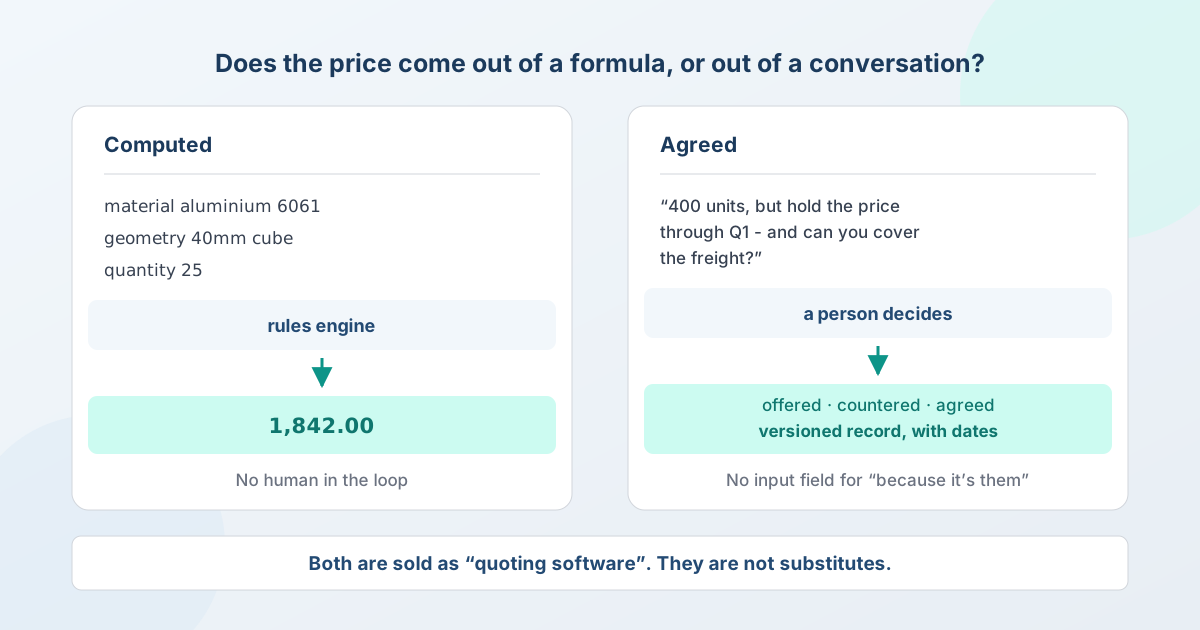
There are two completely different products sold under the word "quote", and one question tells you which one you need: does your price come out of a formula, or out of a conversation?
If a price can be computed from measurable inputs - geometry, area, weight, colours, quantity - you want an instant-quote engine, and the work is encoding your pricing rules. If a price has to be agreed with a person because it depends on the relationship, the volume commitment, the freight you're willing to eat, or what the competition quoted, you want a negotiated-quote tool, and the work is keeping an accurate record of what was agreed.
Both are called quoting software. They are not substitutes, they do not compete, and buying the wrong one is an expensive way to find out which you needed.
The one question that decides it
Write down how you got to the last five prices you sent. For each one, could a formula have produced the same number from inputs a buyer could have typed in themselves?
- "Aluminium, 6 parts, 3-axis, 40mm cube, tolerance ±0.05, 25 units" - computable. Material cost, cycle time and setup are all derivable from the geometry.
- "300 shirts, 2 colours front, 1 back, mixed sizes" - computable. Garments, screens, placements and run length are a formula the industry already uses.
- "480 sq ft, engineered oak, stairs included" - computable. Area times material plus labour.
- "They want 400 units but only if we hold the price through Q1, and they're asking us to cover the freight" - not computable. There is no input field for "hold the price through Q1".
- "Existing account, reordering, but they've asked what we can do on the price this year" - not computable. The answer depends on what you want the relationship to be.
If four of five were computable, your problem is a pricing engine. If four of five were not, your problem is a record.
Most B2B stores find they have both, in a ratio - and the ratio matters more than the total, because it tells you which half to automate and which half to staff.
What an instant-quote engine actually does
An instant-quote engine turns inputs into a number without a human in the loop. The category is mature and the good ones are deeply specialised, because the hard part isn't the quote - it's the domain model underneath it.
- Machining and fabrication - the buyer uploads a CAD file and the engine does feature recognition, estimates cycle time, toolpaths, setup and material removal, and prices from that. DigiFabster, Oroox and CloudNC all work this way.
- Apparel decorating and print - a calculator prices garment, decoration method, colour count, placements and run length, usually with per-client rate profiles. On Shopify, custom price calculator apps cover the formula end; shop-management platforms like shopVOX wrap it in job tracking.
- Trades and installation - area, material and labour rates, often with a visit to confirm.
What they all have in common is a rules engine: a place where you encode the arithmetic once so it can run thousands of times without you. That's the value, and it's why they're worth their price if your pricing really is arithmetic.
What they don't do is negotiate. An instant-quote engine has no opinion about a buyer who accepts three of your five lines, asks you to defer the fourth, and wants the fifth priced differently next quarter. That's not a formula input.
What a negotiated-quote tool actually does
A negotiated-quote tool assumes a person sets the price and its job is to make the resulting agreement survive contact with reality. The work is in the record, not the arithmetic.
- Capture the request properly so you can price it without a follow-up email - specs, quantities, dates, files.
- Hold the versions. What you offered, what they countered, what you countered back, with timestamps. Six months later "what did we actually agree?" has one answer.
- Handle a partial answer. A buyer who accepts some lines and leaves others open has not declined the rest - those lines are still open, and the tool has to represent that rather than flattening it to yes or no.
- Convert without re-keying. The agreed lines and prices become a real order at the agreed figures, not a hand-copied approximation.
None of that requires computing a price. All of it requires knowing exactly which price was agreed, by whom, and when.
Where the two get confused
They get confused at the search box, because the disambiguating word is usually missing. Someone typing "quoting software" could want either. The words that reveal which are:
| If the search says | The searcher wants |
|---|---|
| calculator, instant, online, per-unit, cost | A formula. Price computed from inputs |
| template, format, what to include, sample | A document. The anatomy of the quote itself |
| approval, terms, PO, follow-up, partial | A process. The workflow around an agreed price |
| record, version, audit, history | Evidence. What was agreed and when |
The last three all point at negotiated quoting, and only the first points at a pricing engine. It's worth knowing which row you're in before you shortlist anything, because vendors in both categories answer to "quoting software".
What picking wrong costs you
Buying a pricing engine for negotiated work means encoding rules for prices that were never rule-shaped. Teams do this, discover the rules can't express "because it's them", and end up overriding the engine on most quotes - at which point they're paying for arithmetic they don't use and still have no record of the override reasoning.
Buying a quote-record tool for computable work means a human retyping a calculation a machine could have done, on every single request, while the buyer waits. The record is immaculate and the response time is terrible.
Neither failure shows up in a demo. Both show up about six weeks in.
A test for your own pricing
Five questions. Answer them about your actual last month, not your intentions.
- Could a buyer have self-served the price from inputs they already know? If yes, a formula can do it.
- Does the same request from two different buyers get two different prices? If yes, it isn't a formula.
- When you discount, is the reason a rule or a judgement? Rules encode. Judgements don't.
- Do buyers counter your prices? Formulas don't get countered - they get accepted or abandoned.
- Six months on, do you need to know why a price was what it was? If yes, you need a record regardless of which tool prices it.
If you answered "formula" to 1-4, shortlist instant-quote engines in your trade and stop reading. If you answered "judgement", the rest of this site is about the other half - and question 5 applies either way.
FAQ
What is the difference between an instant quote and a negotiated quote?
An instant quote is computed from inputs by software, with no human in the loop - upload a drawing or enter dimensions and get a price immediately. A negotiated quote is a price a person sets and then agrees with the buyer, usually after at least one counter. The first needs a pricing rules engine; the second needs an accurate versioned record of what was agreed.
Can one tool do both?
Partly, and rarely well. Instant-quote engines add manual override so a human can adjust the computed figure, and quote apps let you enter any price you like including one a calculator gave you. But the hard part of each is different - a domain model in one, an audit trail in the other - so a tool that is genuinely strong at one is usually thin at the other.
Does QuotWay calculate prices automatically?
No. QuotWay has no pricing formula engine and no price-list engine. You set the price on each line yourself, and QuotWay keeps the request, the negotiation and the agreed figures on one record and converts the accepted result into a Shopify draft order. If your prices should be computed from inputs, a purpose-built calculator for your trade is the right tool.
Which one do most Shopify B2B stores need?
Most need the negotiated kind, because the products are standard and the price is what varies by customer. Stores selling genuinely made-to-order work - machining, fabrication, custom print - often need both: a calculator for the routine configurations and a negotiated record for the deals that fall outside them.
Is CPQ the same as an instant-quote engine?
They overlap but aren't the same. CPQ is enterprise sales software that configures a product from options, prices it against rules, and produces a formal quote with approval hierarchies and CRM integration. An instant-quote engine is usually narrower and deeper - one trade, one pricing model, buyer-facing and self-serve.
Where QuotWay fits
QuotWay is a B2B quote and negotiation app for Shopify, built by EFOLI. It is firmly on the negotiated side of the line drawn above: it captures the request, keeps every version of the negotiation, lets a buyer accept part of a proposal while the rest stays open, and converts the agreed lines into a native Shopify draft order at the agreed figures. It does not compute prices from inputs, and it isn't trying to - see how negotiation works, or the plans and pricing. If your work is made-to-order but priced by a person rather than a formula, quoting for manufacturing and custom orders is the closer fit. If you're weighing this against enterprise sales software, CPQ for Shopify covers that comparison, and when to automate B2B quotes covers which of your negotiated quotes can run without you.
Sources
Related articles
See how QuotWay handles this on your store.