For Shopify agencies
Is Shopify good for B2B? When it's the right platform, and when it isn't
By Jahangir Alam · October 11, 2026 · 14 min read
- Last verified
- Shopify API
- 2026-10
- Audience
- Merchants and Shopify agencies deciding whether Shopify is the right platform for a B2B business
- Scope
- Native Shopify B2B at API 2026-10: blended and dedicated stores, features by plan, hard limits (variants, options, lines, companies, catalogs, locations, API), what Shopify says it doesn't do natively (punchout, EDI, buyer approvals, hierarchies, credit limits, POS), punchout explained, a fit decision table, and what BigCommerce, Adobe Commerce, Salesforce, SAP Commerce Cloud, OroCommerce and Shopware document for the same capabilities
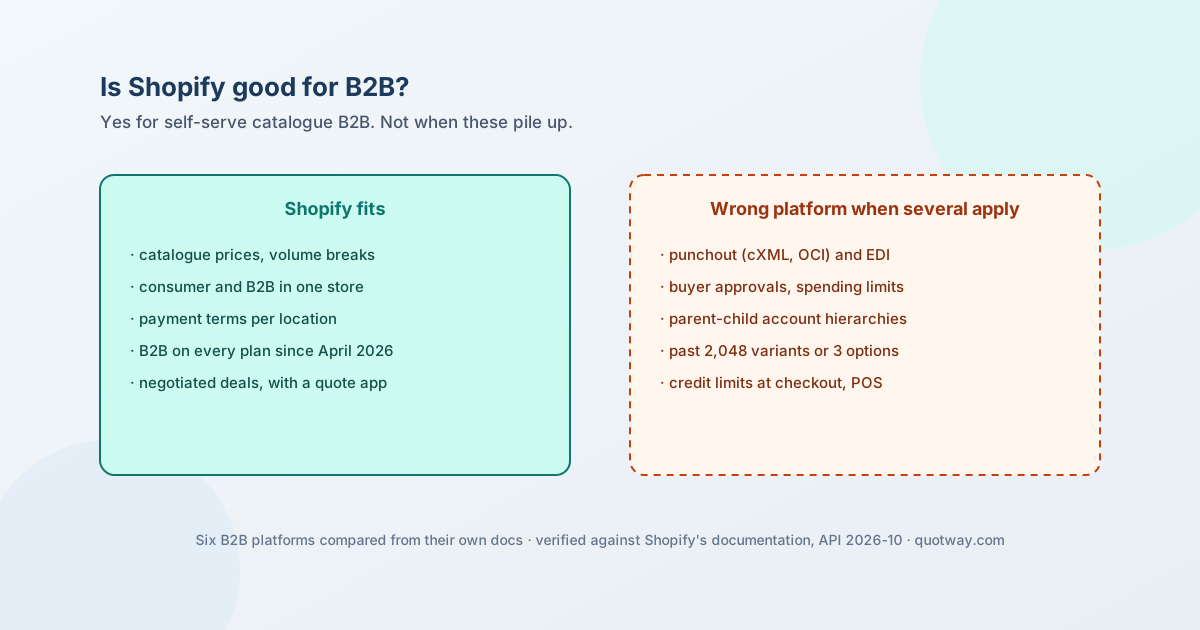
Yes - Shopify is good for B2B when you sell a catalogue to business buyers who order themselves at fixed or tiered prices, on payment terms, from one store that can serve consumers too. Since 2 April 2026 that is included on every Shopify plan. It is the wrong platform, or the start of a large integration project, when several of these apply at once: buyers order from a procurement system through punchout, trading partners need EDI, the buyer's own managers must approve orders or enforce spending limits, accounts are multi-level hierarchies, products are configured beyond 2,048 variants, credit limits must be enforced at checkout, or sales happen at a counter at company prices.
This page sets out what Shopify B2B does on each plan, the hard limits that only matter at scale, what Shopify itself says it doesn't do natively, how six other B2B platforms document the same capabilities, and where a quote app closes a gap and where it can't. Every Shopify fact links to the Shopify B2B reference or to Shopify's own page; every fact about another platform comes from that vendor's own documentation.
Everything below was checked against the vendors' own pages on 11 October 2026, at Shopify API version 2026-10; sources are at the end. We name no ranking and print no prices - pricing pages change, so we link them instead.
Is Shopify B2B or B2C?
Both. Shopify supports a blended store - "a single Shopify store that's used for both B2B and D2C customers" - and a dedicated B2B store, separate from the consumer store and optionally gated to signed-in buyers. On Shopify Plus a dedicated B2B store can be an expansion store in the same organisation. Shopify warns that the choice is "not easy to change at a later time", so make it before any data exists (technical debt that gets expensive later). A buyer who isn't a contact on a company location is treated as a consumer, even when signed in.
What Shopify B2B does, by plan
| On every plan (Basic, Grow, Advanced, Plus) | Only on Shopify Plus |
|---|---|
| Companies with locations and contacts; location-level permissions | Unlimited catalogs (off Plus: 3 active across all B2B markets) |
| Catalogs with price lists, quantity rules and up to 10 volume price breaks per product | Assigning a catalog directly to a company or location |
| Payment terms per location (Net 7-90, due on fulfilment, fixed date), payment reminders, vaulted cards | Deposits, partial payments, payment requests per fulfilment |
| Draft orders to invoice; "submit all orders as drafts for review"; PO numbers; reorders | Expansion stores (one free B2B store per contract) |
| Up to 10 sales staff per company location; quick order list; the Trade theme; Flow B2B triggers and actions | A higher API budget; custom apps with Functions or Flow extensions |
Do you need Shopify Plus for B2B? walks through the plan decision; Shopify B2B features explained explains each row.
The hard limits that matter at scale
| Limit | Value at API 2026-10 |
|---|---|
| Variants per product | 2,048 by default |
| Options per product | 3 - the API rejects a fourth |
| Line items per order or draft order | 500; 499 through the draft-order API |
| Locations and customers per company | 10,000 each; 50 customers per company location |
| Companies per customer | 1 - a customer can belong to only one company, at several of its locations |
| Catalogs | 3 active across all B2B markets off Plus; 25 per company location; 10,000 per store |
| Volume price breaks | 10 per product, applied per variant |
| Store (inventory) locations | 10 on Basic, Grow and Advanced; 200 on Plus |
| New variants per day, once a store has 500,000 | 10,000 - except on Plus |
| GraphQL Admin API | 100, 200, 1,000 or 2,000 points per second (Standard, Advanced, Plus, Commerce Components) |
Two more behaviours matter to B2B operations. An order in Pending payment - where an order on net terms sits until it's paid - is one Shopify says you "might be unable to edit order items and discounts" on. And B2B doesn't support Shopify's purchase options - subscriptions and try-before-you-buy among them - and is incompatible with accelerated checkouts such as Shop Pay. Count variants, options and price segments before choosing the platform: these are platform limits, not configuration, and the workaround changes the data model.
What Shopify B2B doesn't do natively
Stated the way Shopify states it:
| Capability | What Shopify says or documents |
|---|---|
| Punchout (cXML, OCI) | "Shopify does not offer native PunchOut but supports it through partner integrations." Third-party App Store apps list cXML and OCI punchout |
| EDI | Shopify "handles EDI through apps or middleware" |
| Quotes, RFQ and negotiation | There is no quote object; a draft order has three statuses and no versions or counter-offers (why a draft order is not a quote) |
| Buyer-side approvals and spending limits | Company contacts have two roles, "Ordering only" and "Location admin", with no approval or spending setting. "Submit all orders as drafts for review" sends the order to the merchant, not to the buyer's manager. Shopify's B2B page points to apps for custom buyer roles |
| Account hierarchies | Two levels: a company is "the parent organization for one or more company locations". Shopify documents no company-of-companies, and a customer belongs to one company |
| Requisition lists | The B2B feature list has quick order lists and reorders, but no saved requisition list |
| Multiple ship-to addresses per order | An order has one shipping address |
| Credit limits | Shopify's B2B pages list payment terms and store credit for a company location, not a credit limit; terms are not charged automatically when they expire |
| Configured products (CPQ) | 3 options and 2,048 variants per product, and no rules engine (Shopify and CPQ) |
| Company prices at POS | A Shopify Staff reply on the community forum (5 October 2026) says companies and B2B catalogs "don't carry over to the register" |
What is punchout?
Punchout lets a buyer shop a supplier's store from inside their own procurement system - Shopify's guide names Coupa and SAP Ariba. The buyer "punches out" to the supplier, builds a cart, and the cart returns to the procurement system as a requisition for internal approval; the order comes later. Two protocols carry it. cXML is, in its maintainers' words, a protocol for "communication of business documents between procurement applications, e-commerce hubs and suppliers", and its punchout "is not a link to a web site" but "a dialog of real-time, synchronous cXML messages". OCI is SAP's Open Catalog Interface. On Shopify, punchout comes from a third-party app; check each app's support for B2B catalogs and company locations before you commit.
Shopify's own B2B examples
Shopify's own customer stories for B2B include Brooklinen, which "added a second store exclusively for B2B buyers within the same admin"; Kulani Kinis, which runs a "dedicated expansion store that is only used for wholesale customers"; and Snyder Performance Engineering, which sells to "repair shops nationwide" with customer-specific pricing and payment terms. All three are brands selling a catalogue to business buyers through a self-serve store. None of the three stories describes punchout, EDI or buyer-side approvals - an observation about three pages, not about Shopify's customer base.
When Shopify fits, and when it doesn't
| Signal | Points to | What closes it |
|---|---|---|
| Business buyers self-serve a catalogue at fixed or tiered prices | Shopify fits | Native: catalogs, quantity rules, volume breaks |
| You run consumer and business sales together, from one inventory | Shopify fits | Native: a blended store |
| Price segments fit in 3 active catalogs, or you are on Plus | Shopify fits | Native; Plus for more or direct assignment |
| Net, fixed-date or on-fulfilment terms per location | Shopify fits | Native; deposits and partial payments on Plus |
| Prices are negotiated per deal on standard products | Shopify fits, with a quote layer | A quote app (native, app, custom or CPQ) |
| Buyers order from Coupa, Ariba or SAP through punchout | Integration project | A third-party punchout app |
| Trading partners require EDI | Integration project | EDI apps or middleware |
| Buyers' managers approve orders or enforce spending limits on every order | Integration project, or another platform | A buyer-controls app; another platform with buyer approvals |
| Group, subsidiary and branch accounts with contacts across subsidiaries | Another platform, or a custom model | Platforms that document parent-child accounts (below) |
| Products past 2,048 variants or 3 options, or priced by rules | Another platform or CPQ | A configurator; split products |
| Orders over 500 lines, or several ship-to addresses per order | Another platform, or split orders | - |
| Credit limits enforced at checkout | ERP-led | The ERP owns credit; Shopify takes the order |
| Counter sales at company prices | Another channel | - |
One signal from the lower half doesn't have to decide it. Several at once, each needing its own integration, is when Shopify stops being the cheaper platform - and we publish no threshold for "several", because no dataset supports one.
How other B2B platforms document the same capabilities
What each vendor's own documentation says, read on 11 October 2026. Yes means the vendor documents it as a platform or first-party B2B feature; partner means only through a third-party app or partner integration; partial means documented with a stated limitation; not found means not found in the documentation we opened, which is not the same as "doesn't have".
| Capability | Shopify | BigCommerce B2B Edition | Adobe Commerce B2B | Salesforce B2B Commerce | SAP Commerce Cloud | OroCommerce | Shopware B2B Components |
|---|---|---|---|---|---|---|---|
| Quotes and RFQ with negotiation | Not native (apps) | Yes | Yes | Yes | Yes | Yes | Yes |
| Buyer-side purchase approvals | Not native (apps) | Partial - shopping-list approval by role | Yes - approval rules | Not found | Yes | Partial - documented as a customisation | Yes |
| Parent-child account hierarchy | No - two levels | Yes | Yes | Partial | Yes | Yes | Yes - organisation units |
| Customer-specific catalogs and price lists | Yes | Yes | Yes | Yes | Yes | Yes | Yes |
| Requisition or shopping lists | Quick order list, reorders | Yes | Yes | Partial - wishlists | Partial - saved carts | Yes | Yes |
| Quick or bulk order | Yes | Yes | Yes | Yes | Yes | Yes | Yes |
| Punchout (cXML, OCI) | Partner | Partner | Partial - a punchout setting, no protocol handler documented | Partner | Yes - a cXML punchout module | Partner | Partner |
| EDI | Apps or middleware | Not found | Not found | Partial - imports EDI-originated orders | Not found | Not found | Not found |
| Payment terms; credit limits | Terms yes; credit limit not found | Yes - including credit limit | Yes - payment on account up to a credit limit | Partial | Partial - budgets | Partial - terms | Partial - budgets |
| Deployment | Shopify-hosted | BigCommerce-hosted | SaaS, PaaS or on-premises | Salesforce cloud | SAP-operated cloud | Open-source Community Edition, Enterprise, OroCloud or on-premises | Self-hosted, SaaS or PaaS |
| Where B2B lives | Every plan; extras on Plus | B2B Edition on the Enterprise plan | A separately licensed B2B extension for Adobe Commerce | A B2B Commerce licence | The B2B Accelerator / module | Community and Enterprise editions | B2B Components from the Evolve plan |
Three things the table shows. Every other platform here documents a native quote flow; Shopify doesn't, which is why quote apps exist on it. Only SAP documents a first-party cXML punchout module; the others, Shopify included, rely on partners. And every other platform puts its B2B features in a named edition, licence or plan above its entry tier, where Shopify includes B2B on every plan.
Two of the vendors document a transition worth knowing about: SAP is retiring its Accelerator storefronts in favour of its composable storefront, and Shopware says its older B2B Suite is no longer supported from Shopware 6.8, in favour of B2B Components.
BigCommerce vs Shopify for B2B
On the documented features, the two overlap on company accounts, customer-specific catalogs and price lists, quick ordering and payment terms. What BigCommerce's B2B Edition documents and native Shopify doesn't: a buyer quote flow with negotiation, shopping lists that a junior buyer submits for approval, a company hierarchy with custom roles, and a credit limit with credit hold per company. What differs the other way: Shopify includes B2B on every plan, where BigCommerce places B2B Edition on its Enterprise plan. Both rely on partner apps for punchout. If the gaps that matter to you are quotes and buyer roles, compare BigCommerce's native features with Shopify plus apps; if they are punchout or EDI, both need a partner.
Where a quote app closes the gap, and where it can't
A quote app fills the gaps that are deal states Shopify has no object for: a request, a negotiated price, counter-offers, approvals on the quote, and a converted draft order. QuotWay, as one example: proposals are versioned and locked once sent, buyers counter, and an accepted quote converts to a native Shopify draft order carrying Shopify payment terms - payment terms and conversion on every plan, including free Lite. Merchant approval workflows and buyer-side approval chains are on Professional and above, and they apply to quotes, not to ordinary catalogue checkout orders. Company-aware quoting with Companies and Locations is on Enterprise (plans).
What a quote app can't add, because each is a platform or integration surface rather than a deal state: punchout, EDI, ERP-native contract pricing, a credit-limit ledger, company prices at POS, parent-child accounts, or more than 2,048 variants. QuotWay offers none of those. When you shouldn't use a Shopify quote app covers the cases where Shopify fits and a quote app isn't needed either; Shopify B2B with QuotWay covers what it adds when it is.
FAQ
Is Shopify good for B2B?
Yes, for selling a catalogue to business buyers who order themselves at fixed or tiered prices, with payment terms, on any Shopify plan since 2 April 2026. It is a weaker fit when buyers need punchout, EDI, buyer-side approvals and spending limits, multi-level account hierarchies or configured products beyond 2,048 variants - each needs an app, an integration or another platform.
Is Shopify B2B or B2C?
Both. One store can sell to consumers and businesses (a blended store), or a separate store can be B2B only (a dedicated store; on Plus, an expansion store). Shopify says the choice is not easy to change later.
What are Shopify Plus B2B features?
Unlimited catalogs and direct assignment to companies and locations, deposits, partial payments and payment requests per fulfilment, expansion stores, a higher API budget, and custom apps with Functions or Flow extensions. Everything else in Shopify B2B is on every plan.
What is punchout?
A buyer starts in their procurement system, "punches out" to the supplier's store, builds a cart, and sends it back to the procurement system as a requisition for internal approval. cXML and OCI are the two protocols used.
Does Shopify support punchout?
Not natively. Shopify's own guide says it "does not offer native PunchOut but supports it through partner integrations"; third-party App Store apps offer cXML and OCI punchout. Check each one's support for your B2B catalogs.
Does Shopify support EDI?
Through apps or middleware, in Shopify's words; Shopify doesn't document a native EDI connector.
Can a buyer's manager approve orders before they're placed on Shopify?
Not in Shopify's B2B features: company contacts are "Ordering only" or "Location admin", and "submit for review" sends the order to the merchant. Apps add buyer-side approvals; on quotes, a quote app can add them - in QuotWay, on Professional and above.
Is BigCommerce better than Shopify for B2B?
It depends on the gap. BigCommerce's B2B Edition documents native quotes, shopping-list approvals, a company hierarchy and credit limits, which native Shopify doesn't; Shopify includes B2B on every plan, where B2B Edition is on BigCommerce's Enterprise plan. Both rely on partners for punchout.
What is the best B2B ecommerce platform?
There isn't one answer: it depends on which capabilities your buyers need - quotes, buyer approvals, account hierarchies, punchout, EDI - and on where you want B2B to live (an included feature, an edition or a licence) and how it is hosted. The comparison table above shows what each vendor documents.
How many variants can a Shopify product have?
2,048 by default at API version 2026-10, with up to 3 options.
Sources
Read on 11 October 2026, at Shopify API version 2026-10:
Shopify
- B2B features by plan, overview of B2B features, requirements and considerations and choosing a store type
- Creating companies, adding customers to companies, company contacts and checkout settings
- B2B catalogs, store credit, editing orders - considerations and location limits
- Apps and B2B, Company, CompanyContactRole, Order, Product, productOptionsCreate, rate limits
- Shopify B2B and Shopify's B2B ecommerce website development guide (punchout and EDI)
- Customer stories: Brooklinen, Kulani Kinis, Snyder Performance Engineering
- Shopify Staff on the community forum: B2B customers in POS
Punchout standards
- cXML and the cXML FAQ; SAP, Open Catalog Interface 5.0
Other platforms (each vendor's own documentation)
- BigCommerce: B2B Edition overview, quotes, company entities and roles, credit and payment, B2B Edition app
- Adobe Commerce: B2B introduction, purchase order approval rules, extensions and licensing, product solutions
- Salesforce: B2B Commerce and D2C Commerce (Spring '26), B2B ecommerce
- SAP Commerce Cloud: B2B Commerce, B2B PunchOut module, approval process, composable storefront
- OroCommerce: RFQs and quotes, customers, pricing, procurement integrations, editions and repositories
- Shopware: B2B Components, order approval, organisation units, B2B Suite migration, pricing and plans
Competitor capabilities are described only as each vendor documents them; "not found" means not found in the documentation we opened.
Related articles
- For Shopify agenciesWhy a quote converts at the wrong price on Shopify: diagnose it by the size of the difference13 min read
- For Shopify agenciesWhen the quote and the Shopify order disagree: what drifts after conversion12 min read
- For Shopify agenciesBuild vs buy: what a custom Shopify RFQ app has to run in 202614 min read
See how QuotWay handles this on your store.