B2B strategy
Your CRM says the deal is lost. Your buyer says they're still thinking.
By Jahangir Alam · September 16, 2026 · 8 min read
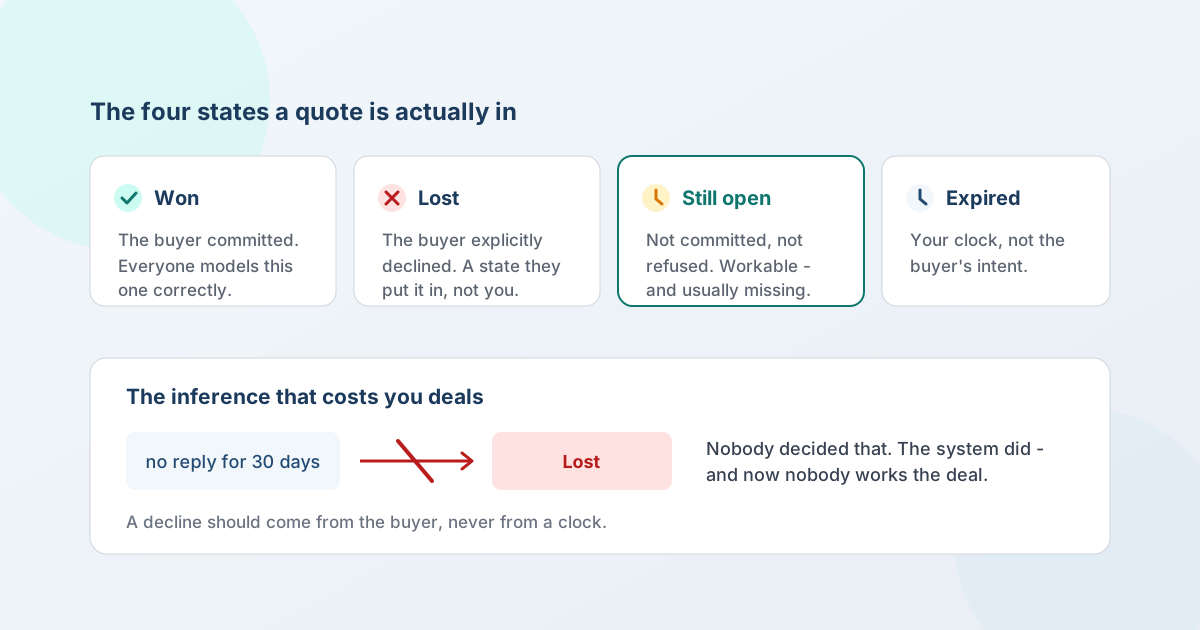
Your pipeline says the deal is lost. The buyer, if you called them, would say they're still thinking about it. Both are honest reports, and they disagree because your system was asked a question the buyer never answered.
This is one of the quieter ways B2B pipelines go wrong. It doesn't look like a bug - the quote has a status, the report runs, the number is a number. It just describes something that isn't true, and the cost of that is deals nobody works because the record says there's nothing to work.
Where the gap comes from
Most quoting tools model a quote as a yes/no question. The buyer accepts, or the buyer declines. Everything else - the reply that never came, the "leave it with me", the half of the order they were ready for - has to be squeezed into one of those two, or into a third bucket that means we don't know.
So the states drift apart from reality in a specific way:
- Silence becomes "lost". Nobody decided that. The system inferred it, usually from an expiry date, and the inference is now a fact in your forecast.
- "Not now" becomes "no". A buyer who wanted the order in the next budget cycle is indistinguishable from a buyer who went elsewhere.
- Partial interest becomes nothing. A buyer who wanted eight of eleven lines, and said so in an email, shows up as an unanswered quote.
None of these are reporting errors. They're modelling errors that arrive dressed as reporting.
The states that actually exist
A B2B quote can be in one of four honest states, and the fourth is the one most systems don't have:
Won. The buyer committed. Unambiguous, and the only one everyone models correctly.
Lost. The buyer explicitly declined, or told you they bought elsewhere. Note the word explicitly - this is a state the buyer puts the quote into, not one you deduce.
Still open. The buyer hasn't committed and hasn't refused. They're waiting on a budget, a board, a site survey, or a second quote. This is a real, common, workable state, and if your system doesn't have it, every quote in it is being misfiled into one of the other two.
Expired. The offer lapsed. This is a decision your system made about your price - not a statement about the buyer's intent. An expired quote from a buyer who still wants the goods is not a lost deal; it's a live opportunity with a stale number attached.
The fourth one is where most of the damage is, because expiry is automatic and feels objective. It isn't. It's a clock you set.
What a wrong "lost" costs you
Three things, and they compound:
You stop working it. This is the direct cost and the largest. A deal marked lost is a deal nobody follows up, nobody includes in a re-quote when prices move, and nobody thinks about when the buyer's budget frees up. The record closed a door the buyer left ajar.
Your forecast is wrong in both directions. Deals that should be in the pipeline aren't, so you under-forecast. And because the "lost" bucket is full of quotes that were never actually decided, you lose the ability to learn anything from it - the losses you could analyse are buried under the ones that were just silence.
Your win rate stops meaning anything. Win rate is wins over decided quotes. If undecided quotes are being filed as losses, the denominator is inflated with deals that never reached a decision, and the number drifts down for reasons that have nothing to do with how you sell. (B2B analytics on Shopify covers the difference between win rate and conversion rate, and why you need both.)
A quick caution while we're near numbers: there is no credible published benchmark for how many B2B quotes "should" be won, lost or open. The figures that circulate come from vendor pages with no disclosed sample - we traced the main ones. Compare your own trend on a fixed definition; don't calibrate against folklore.
Make deferral a first-class answer
The fix isn't better reporting on top of the same two states. It's giving the buyer somewhere honest to put "not yet", so the state comes from them rather than from an inference.
In QuotWay, every line of a sent proposal carries its own decision - accept, decide later, or decline - in the Shopify customer account and the hosted buyer portal, submitted together. That third option is the point. A line the buyer defers is reported as still open, never as declined, and your quote timeline summarises the submission as "2 accepted · 1 declined · 1 still open" with each line's outcome.
Two consequences worth spelling out:
- A decline now means something. Because deferring is available and easy, a buyer who declines has actually decided. Your lost bucket becomes analysable for the first time.
- You can win the rest later. The deferred lines stay attached to the quote with their full negotiation history, so picking them up in six weeks doesn't mean rebuilding the deal from an email thread.
Per-line decisions are on the Professional plan and above; whole-quote acceptance and decline work on every plan. The mechanics are in accept part of a quote.
Pipeline hygiene that follows from this
Once the states are honest, a few practices keep them that way:
- Age your open pipeline, don't purge it. A quote open for 90 days isn't the same as one open for six, and neither is automatically lost. Sort by age and work the recoverable ones; the number you should watch is how much of your open value is old, not how much exists.
- Treat expiry as a prompt, not a verdict. When a quote lapses, that's a reason to make contact - "this needs re-pricing, is it still live?" - not a reason to file it as lost. How long should a B2B quote be valid covers choosing the window.
- Ask for the close. The most under-sent email in B2B is the one that asks whether to close the file. An honest "we went with someone else" is worth more than an open quote pretending to be forecast. How to follow up on a quote has the wording.
- Never let the system infer a decline. If the buyer didn't say no, the record shouldn't say no. That's a rule about your process as much as your software.
What to check in your own pipeline this week
If you want to know whether this is costing you anything, the diagnostic is quick:
- Pull every quote marked lost in the last quarter.
- Split them into ones where the buyer explicitly declined, and ones where the status came from silence or an expiry date.
- Look at the value of the second pile.
That second number is your inferred-loss exposure - deals that were closed by a clock rather than by a buyer. In most pipelines it is larger than people expect, and every one of them is a conversation you're allowed to restart.
FAQ
What's the difference between a lost quote and an open one?
A lost quote is one the buyer explicitly declined, or told you they placed elsewhere. An open quote is one they haven't committed to and haven't refused - waiting on a budget, an approval, or another supplier's price. The distinction matters because a lost deal is closed and an open one is still winnable, and most systems collapse the two by inferring a loss from silence or an expiry date.
Does an expired quote mean the deal is lost?
No. Expiry is a decision your system made about your price, not a statement about the buyer's intent. A quote can lapse while the buyer is still very much interested. Treat an expiry as a prompt to re-price and make contact rather than as a verdict, and keep the two states separate in your reporting.
How do I stop my pipeline reporting deals as lost when they aren't?
Give the buyer a way to say "not yet" that your system records as its own state. In QuotWay each line of a proposal can be accepted, declined, or deferred, and a deferred line is reported as still open rather than declined. Then make it a process rule that a decline has to come from the buyer - never from an expiry date or a silence.
What should I do with a quote that's been open for months?
Age it rather than purge it. Sort your open pipeline by age, work the recoverable ones, and send the email that asks whether to close the file - a clear "no" is more useful than an ambiguous "maybe" sitting in your forecast. If the pricing has moved, re-quote rather than reissuing a stale number.
Which plan do I need for per-line decisions?
Professional and above. On the free Lite plan and Starter the buyer accepts or declines the proposal as a whole, which still works - the difference is that per-line decisions let a single quote carry accepted, declined and still-open lines at the same time. See pricing.
Where QuotWay fits
QuotWay is a B2B quote and negotiation app for Shopify, built by EFOLI. It keeps the four states apart on purpose: accepted lines are settled, declined lines stay visible on the quote rather than being deleted, deferred lines are reported as still open and stay negotiable, and expiry is a prompt rather than a verdict - a quote that's mid-negotiation on your side is never auto-expired. Per-line decisions are on Professional and above; the free Lite plan runs the whole quote → negotiate → draft-order loop. See negotiation and proposals, analytics and insights, the plans and pricing, or add QuotWay on Shopify.
Related articles
See how QuotWay handles this on your store.