B2B strategy
Volume and tiered pricing on Shopify B2B: quantity breaks and quotes
By Jahangir Alam · August 20, 2026 · Updated October 7, 2026 · 12 min read
- Last verified
- Shopify API
- 2026-10
- Audience
- B2B merchants building volume or tiered pricing on Shopify
- Scope
- Volume and tiered pricing on Shopify B2B at API 2026-10: quantity rules (minimum, maximum, increment), up to 10 price breaks per product and how they must line up with the rules, and when a standing tier should be a negotiated quote instead
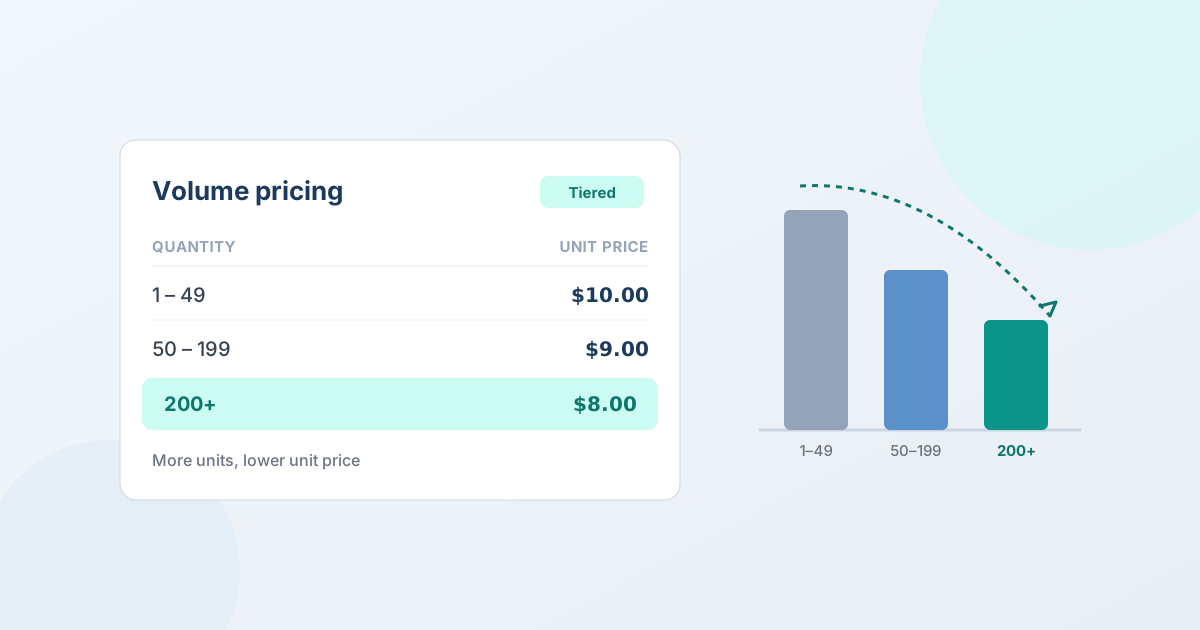
B2B pricing rewards volume: the more a buyer orders, the less they pay per unit. On Shopify there are two ways to run volume and tiered pricing, and they solve different problems - standing tiered price lists you publish in advance, and negotiated volume pricing you agree per deal. This is a complete guide to both: the economics behind volume pricing, how to structure your tiers, how to set each up on Shopify, and the honest boundary between a pricing engine and a quote.
Why B2B pricing rewards volume
Volume pricing isn't a discount you give away - it's a reflection of real economics, which is why it's worth getting right rather than guessing.
- Fulfillment cost per unit falls with quantity. Picking, packing, shipping, invoicing, and handling a 500-unit order costs far less per unit than a 5-unit one. Volume pricing passes some of that saving back to the buyer while keeping the rest as margin.
- Bigger orders are worth winning. A lower per-unit price that lands a 1,000-unit order can beat full price on an order you don't win at all. Volume tiers are how you compete for the orders that move the needle.
- Buyers expect it. In B2B, "what's your price at volume?" is a reflex. If you don't have an answer ready, you look like you're making it up - and you probably are.
The question on Shopify isn't whether to offer volume pricing - it's how to set it up so it's consistent, protects your margin, and doesn't turn into a pile of one-off email discounts.
Volume, tiered, and quantity-break pricing: the same idea, three names
These terms all describe pricing that scales with quantity, and they're used interchangeably:
- Volume discount - a lower price when the buyer orders more (10% off at 100 units).
- Tiered pricing - price bands by quantity (1-49 at $10, 50-199 at $9, 200+ at $8).
- Quantity breaks - the thresholds where the price drops.
They're the same mechanism framed differently: a volume discount describes the benefit, tiered pricing describes the structure, and a quantity break is the threshold. What matters is how you actually deliver it on Shopify, and that comes down to whether the pricing is standing or negotiated.
How to structure your price tiers
Before the tooling, the pricing itself. A few principles keep tiers effective and profitable:
- Base your breaks on real cost, not round numbers. Set quantity breaks where your cost per unit actually changes - a full case, a pallet, a production-run minimum - not at arbitrary numbers. That way each tier reflects a genuine saving you can afford to share.
- Don't over-tier. Three or four tiers are usually plenty. Ten tiers with 2% steps confuse buyers and complicate your operations without changing behavior. Fewer, meaningful breaks beat many trivial ones.
- Choose fixed prices or percentages deliberately. A percentage off retail is easy to reason about and scales automatically; a fixed per-tier price gives you exact control over margin at each level. Pick per your catalog, but be consistent.
- Protect a floor. Every tier should sit above the point where the deal stops being worth doing. Knowing your floor - the deepest price you'll accept - is what lets you negotiate confidently when a buyer pushes past your published tiers (more on that below).
- Attach quantity rules where they help. Minimums, increments, and case quantities make sure a buyer orders in the units you actually ship, so a "volume" order isn't 47 loose units when you sell by the case of 50.
Get the structure right and the delivery - price list or quote - is just plumbing.
Standing tiered pricing: Shopify B2B price lists
For published, account-specific tiered pricing - a price list a company sees every time it shops - Shopify B2B is the native tool. A company's locations get a catalog with a price list - through a B2B market on any plan, or assigned directly on Shopify Plus - and the catalog carries two settings that work together: quantity rules - a minimum, a maximum and an increment per variant, the increment being how you enforce a case quantity - and volume pricing, the price breaks themselves. One company sees its negotiated tier, another sees a different one, and nobody sees a price they're not entitled to.
The shape Shopify will accept is worth knowing before you design the tiers:
- Up to 10 price breaks per product, applied to each variant. That is the ceiling, not a target.
- Breaks are fixed amounts, not percentages. Each break is a unit price you enter for a minimum quantity - Shopify's setup asks you to "enter a price" for each break, and the API's
QuantityPriceBreak.priceis a money value - not a percentage off. A percentage adjustment belongs to the catalog as a whole. - A break's quantity must be greater than the minimum and a multiple of the increment. So quantity rules and volume pricing are not independent settings - set the minimum and increment first, then place the breaks on them. A break of 45 on a case increment of 50 is not a tier Shopify will take.
This is the right fit when the pricing is standing and known in advance - a wholesale account with agreed break points that apply on every order they place, automatically, when they log in. It's clean, native to Shopify, and it keeps your catalog and inventory intact (no duplicate "wholesale" SKUs). The trade-off is that a price list is a fixed answer: it applies the tier for the quantity ordered, but it doesn't negotiate, and it can't handle a request that falls outside the buyer's list. For how catalogs and price lists fit together, see Shopify B2B catalogs and company-specific pricing.
Negotiated volume pricing: the quote
Not every volume deal is a standing price list. Often a buyer asks for a better rate on a specific large order - "what's your price on 5,000 units?" - and the number is agreed once, for that deal. Sometimes it's a buyer who isn't set up with a price list at all, or wants a rate below their standing tier for an unusually large commitment. That's a quote, not a price list.
With a quote, you price the volume, the buyer can counter, and you agree a number that applies to this order. The buyer requests a price, you send a proposal with the volume pricing, negotiate if needed, and the accepted quote converts to a Shopify draft order at the agreed rate - carried over exactly, with a versioned record of what was agreed. This is the path for the deals a fixed price list can't answer: the big one-off, the special commitment, the new account that needs a number before they're onboarded. See B2B quotes on Shopify and how to negotiate B2B prices without the email chain.
When a buyer wants a rate below your tiers
This is the moment volume pricing gets tested: a buyer likes the 200+ tier but wants the 200+ price at 150 units, or wants to go below your deepest published break for a very large order. A price list can't have that conversation - but a quote can, safely, if you've set a floor.
The floor is the deepest price you'll accept, below which the deal isn't worth doing. With it defined, you can negotiate a one-off rate with confidence: propose, let the buyer counter, and hold the line at your floor rather than guessing under pressure. A guardrail like a price floor means a fast negotiation never accidentally dips below the margin you need - the discount stays inside limits you set, even on a big, tempting order. That's the difference between negotiating from strength and giving away margin because a buyer asked firmly.
Standing or negotiated? A quick rule
- Use a Shopify B2B price list when the tiered pricing is published, account-specific, and applies to every order - a standing wholesale relationship with agreed break points.
- Use a quote when the volume price is negotiated for a specific order, when the buyer wants a rate that isn't on their price list, or when a new account needs a number before they're set up with a catalog.
- Use both when a company has a standing price list and occasionally negotiates a bigger one-off volume - the quote starts from their catalog price and settles on the agreed number.
Most B2B stores end up doing both: a price list for the everyday, a quote for the big or unusual order. They're complementary layers, not a choice you make once.
The honest boundary
Worth stating plainly: a quote app like QuotWay is not a pricing-rules engine. It doesn't manage a tiered price-list system that auto-calculates a per-unit price from quantity - that's what Shopify B2B price lists (or a dedicated pricing app) do. What a quote app does is run the negotiated volume deal: capture the request, price it, negotiate it within your floor, and convert the agreed quote to a Shopify order.
So the split is clean. If your need is standing, rules-based tiered pricing published to accounts, use native Shopify B2B price lists - that's the right tool, and a quote app doesn't replace it. If your need is a negotiated volume price agreed per deal, use a quote. Trying to run standing tiers through a quote app would be tedious; trying to run negotiations through a price list is impossible. They're built for different halves of the same job, and most B2B stores need both.
Why not just use a discount code?
A tempting shortcut is to hand out a discount code for volume - "SAVE10 at 100 units." It falls apart fast in B2B. Codes aren't account-specific, so anyone who gets hold of one pays the trade price. They don't reliably enforce the quantity that earned the discount. They clutter your promotions and checkout, and they leave no clean record of what a specific buyer is entitled to. Volume pricing in B2B has to be tied to the account and the quantity - which is exactly what a price list (standing) or a quote (negotiated) provides, and what a public discount code can't. Discount codes are a retail promotions tool; B2B volume pricing is an account-relationship tool, and the two shouldn't be confused.
A worked example: standing tiers plus a negotiated exception
Say you sell a product at $10 retail and set a B2B price list with three tiers: 1-49 at $9, 50-199 at $8, and 200+ at $7. A wholesale account, Harbor Goods, is assigned that list, so when they log in and order 120 units, they automatically pay $8 a unit - no conversation needed. That's the standing tier doing its job: consistent, self-serve, and published in advance.
Now a second buyer, Delta Trading, wants 3,000 units for a seasonal build and asks for a rate below your deepest published tier. A price list can't answer that, so it becomes a quote. You know your floor is $6.20, so you propose $6.75; Delta counters at $6.40; you settle at $6.60, comfortably above your floor. The accepted quote converts to a Shopify draft order at $6.60 a unit, and the versioned record shows exactly how you got there - useful if Delta reorders and expects the same rate, or disputes it later.
Two buyers, two mechanisms, one store: Harbor is served entirely by the standing price list, Delta by a negotiated quote that started where the price list stopped. Neither required re-keying or a spreadsheet, and the floor kept the big negotiated order from eroding margin. That's the pattern most B2B stores settle into - price lists for the predictable, quotes for the exceptional.
Common mistakes with volume pricing
- Publishing volume prices to the public storefront. Trade pricing on a page anyone can see invites the wrong buyers and undercuts your margin. Gate it behind B2B price lists or a quote, and hide the price for the buyers you target.
- Over-tiering. Ten tiers with tiny steps confuse buyers and complicate operations. Three or four meaningful breaks work better.
- Negotiating without a floor. Agreeing one-off volume rates by feel is how margin leaks. Set a floor and negotiate to it.
- Ignoring quantity rules. Volume pricing without minimums or case quantities produces odd-lot orders that cost more to fulfill than the tier assumed.
- Treating a quote app as a pricing engine. Standing tiers belong in price lists; use the quote for the negotiated deal, not to hand-build price tables.
The Shopify facts in this post are kept current in the Shopify B2B reference (Catalogs, quantity rules and volume pricing), re-verified at every Shopify Edition and quarterly API release.
FAQ
How do I set up volume or tiered pricing on Shopify B2B?
For standing, published tiers, give the company's locations a Shopify B2B catalog with a price list and quantity rules (a minimum, a maximum and an increment per variant) - it applies on every order that company places. For a negotiated volume price on a specific order, run it as a quote instead: the buyer requests a price, you propose the volume rate, and the accepted quote converts to a Shopify draft order.
What's the difference between tiered pricing and a volume discount?
They're the same idea framed differently: a volume discount lowers the price as quantity rises; tiered pricing defines the price bands (the tiers) and the quantity breaks where the price changes. Both reward larger orders. On Shopify B2B, standing versions live in price lists; negotiated versions are handled per deal as a quote.
Does QuotWay set tiered price lists?
No. QuotWay is a quote and negotiation app, not a pricing-rules engine - it doesn't manage standing tiered price lists that auto-calculate per-unit prices from quantity. Native Shopify B2B price lists do that. QuotWay handles the negotiated volume deal: it prices the request, supports counter-offers within your floor, and converts the accepted quote to a Shopify draft order at the agreed rate.
How many pricing tiers should I have?
Shopify allows up to 10 price breaks per product; three or four is usually the right number to use. Set your quantity breaks where your cost per unit genuinely changes - a case, a pallet, a production-run minimum - rather than at round numbers, and avoid over-tiering with many small steps that confuse buyers without changing behavior. Fewer, meaningful breaks are easier to sell and easier to operate.
How do I handle a buyer who wants a price below my published tiers?
Negotiate it as a quote, within a price floor. Set the deepest price you'll accept in advance, then propose and let the buyer counter, holding at your floor. A floor guardrail keeps a fast negotiation from dipping below the margin you need, so you can say yes to a big order without giving away more than the deal can bear.
Do I need Shopify Plus for B2B volume pricing?
No. Shopify B2B - Companies and price lists - is capability-based, not Plus-exclusive, so Basic, Grow and Advanced stores with B2B enabled can use price lists and quantity rules. Quoting a negotiated volume price works on any plan through a quote app, native B2B or not.
Do volume tiers require a minimum order quantity?
Not necessarily, but on Shopify they are linked. A quantity break defines the price at each volume; a minimum order quantity (MOQ) sets the smallest order you'll accept. A catalog's quantity rules set a minimum, a maximum and an increment per variant, and a price break's quantity has to be greater than that minimum and a multiple of that increment - so if you set both, set the rules first and place the breaks on them. For the MOQ side, see minimum order quantities on Shopify.
Where QuotWay fits
QuotWay is a B2B quote and negotiation app for Shopify, built by EFOLI. On volume pricing, its lane is the negotiated deal: a buyer requests a price on a large or unusual order, you send a proposal, counter to the agreed number within your floor, and convert the accepted quote to a native Shopify draft order - starting from the buyer's company price list where they have one. It doesn't replace Shopify B2B price lists for standing tiers; it adds the price conversation for the deals a price list can't cover. The free Lite plan runs the full quote → negotiate → draft-order loop; see Shopify B2B quoting, the plans and pricing, or add QuotWay on Shopify.
Sources
Shopify pages re-verified on 23 September 2026 and 7 October 2026:
- Shopify Help Center: B2B on Shopify
- Shopify Help Center: Overview of B2B features on Shopify
- Shopify Help Center: Quantity rules and volume pricing in B2B - the three quantity-rule fields, the 10-break ceiling, and the rule that a break must exceed the minimum and be a multiple of the increment
- Shopify Help Center: Catalogs and pricing in B2B - how a catalog reaches a company, and the three-active-catalog limit off Plus
- QuantityPriceBreak (Admin API 2026-10) - each break is a
minimumQuantityand aprice
Related articles
See how QuotWay handles this on your store.