B2B strategy
Six months later: reading your own quote record
By Jahangir Alam · September 16, 2026 · 8 min read
The quote you send is a sales document. The quote you keep is evidence - and six months later somebody asks it a question.
Usually one of four. The buyer is renewing and wants the same terms: what exactly did we agree? A colleague is reviewing why a deal came in smaller than forecast: why didn't they take the extended warranty? A dispute arrives: they say the price included installation. Or the rep who owned the account has left, and someone has to work out where a negotiation got to from whatever is on file.
Most quoting setups answer the first question and fail the other three, because they were built to produce a document rather than to keep a record. This guide is about the difference, and what a record has to hold to be worth having.
The four questions your own record gets asked
"What did we agree?" The easy one, and the only one a PDF answers. Even here there's a catch: which PDF? The one you sent, or the one after the third round of counters?
"Why didn't they take that?" Asked at renewal, and in every honest win/loss review. It's unanswerable if your system quietly dropped the lines the buyer turned down, which is exactly what a system optimised for a clean-looking document tends to do.
"That's not what was agreed." Rare, expensive, and the one where a reconstructed answer is worth nothing. What settles it is a record that was written as things happened, not assembled afterwards from an inbox.
"Where did this get to, and who allowed it?" The handover question. It needs the sequence, not the outcome: what was offered, what came back, what was conceded, and on whose authority.
Notice that three of the four are about things that didn't happen - lines not taken, prices not agreed, rounds that went nowhere. A record that only keeps the successful path can't answer any of them.
What tends to get lost
- The rejected lines. Deleted at acceptance, because the document looks tidier without them. Now the quote describes what was bought, not what was offered, and the renewal conversation has no baseline.
- The rounds. If each revision overwrites the last, the negotiation collapses into a single final state and nobody can see what moved.
- The reason a price was allowed. A discount that went through with somebody's approval, recorded as a Slack message that has since aged out of your retention window.
- The buyer's own words. The clarification that arrived by email, on which the whole spec turned, living in one person's mailbox rather than on the quote.
- The timing. Not the dates on the PDF, but when things actually happened - which matters the moment anyone argues about what was in force when.
Each of these is lost through a reasonable-looking decision. That's why it's worth deciding deliberately instead.
What a record has to keep
Every round, immutably. Each proposal you send is saved as its own numbered version, and later rounds don't overwrite earlier ones. "What did we agree" becomes a specific answer - version 3 - rather than a description of the current state. See negotiation and proposals.
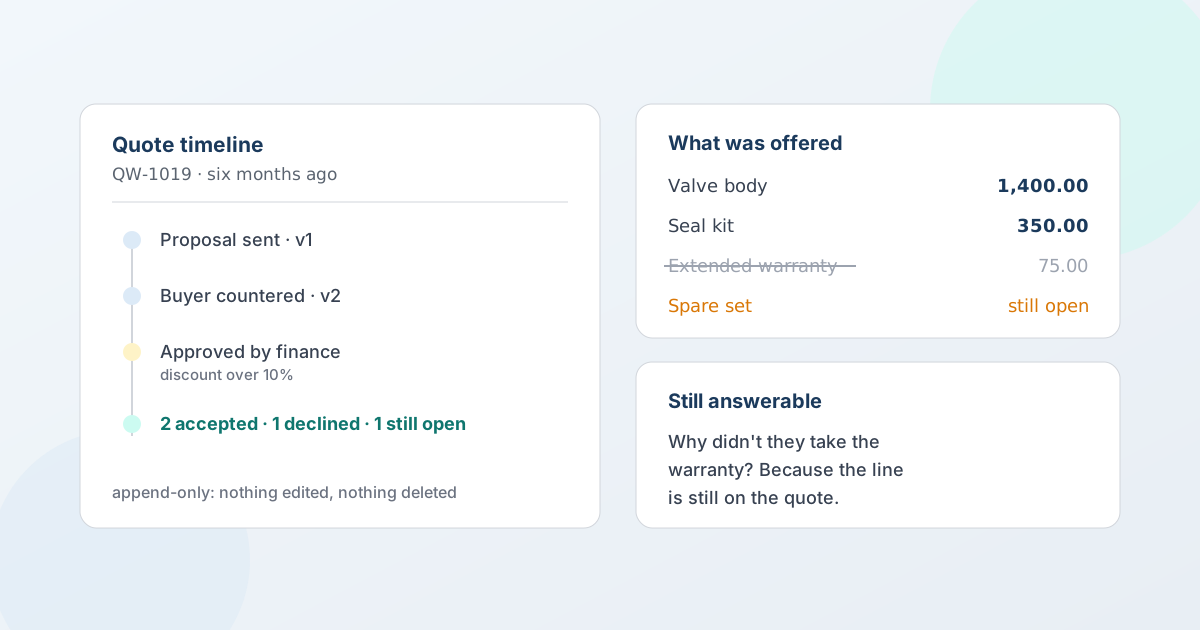
The lines that weren't taken. When a buyer declines a line, it stays on the quote, struck through and marked, rather than being deleted. That single behaviour is what makes the renewal and win/loss questions answerable at all. The quote continues to say what was offered and what happened to each part of it.
The outcome of each line, not just the total. A quote that's partly agreed should read as such. In QuotWay the timeline records an acceptance as "2 accepted · 1 declined · 1 still open" and lists each line's outcome - and a deferred line is reported as still open, never as declined, so the record doesn't overstate what the buyer refused. That distinction is covered in accept part of a quote.
Who approved what, and on what basis. Where a discount or a term needed sign-off, the record should name the approver, the time, and the condition that triggered the step - including steps that were skipped and why. Quote approval thresholds covers designing those rules; the point here is that the audit trail is the output.
The conversation, attached to the deal. Messages and file attachments belong on the quote rather than in an inbox, so the spec revision and the price it justified sit next to each other.
An append-only log. The unifying principle: nothing is edited, nothing is deleted, entries are only added. A record you can rewrite is a record that proves nothing - which is precisely why it's worth knowing that line editing on a live quote is itself audited, with every add and remove written to the timeline.
Two documents, two jobs
It's worth being precise about the paperwork, because it's where records most often contradict themselves.
The Proposal PDF documents what was offered. It lists every line, including ones the buyer later declined, because narrowing it to the accepted subset would misrepresent the offer you actually made.
The Confirmation and Pro-Forma PDFs document what was agreed. On a partial acceptance they list only the accepted lines, under an Accepted total that equals the lines printed beneath it - no discount, shipping, tax or grand-total rows implying the whole quote was bought.
Keeping both is the point. One says what was on the table; the other says what was taken off it. A file with only the second can't answer a renewal question, and a file with only the first can't settle a dispute.
The retention details worth knowing now
Records have lifetimes, and it's better to find that out before you need one:
- Attachments have a retention window that depends on your plan - 30 days on Lite, 90 on Starter, 180 on Professional, 365 on Enterprise. If a drawing or a signed spec is load-bearing evidence, keep your own copy rather than relying on the window.
- Shopify deletes inactive draft orders. A draft order created on or after 1 April 2025 is removed automatically after a year with no activity, and each edit resets the clock. That's Shopify's behaviour, not ours, and it means a draft order is not an archive. (Shopify draft orders: the limits has the detail.)
- The quote record and the order are different things. The order is what shipped; the quote is why it shipped at that price. Keeping the first is not keeping the second.
A five-question test for your own setup
Take a quote you closed six months ago and try to answer these from the record alone, without asking anyone:
- Which version did the buyer accept, and what changed between it and the one before?
- Which lines did they turn down, and is that still visible?
- Was any line left undecided rather than refused?
- Who authorised the price, and what rule required them to?
- What did the buyer say, in their own words, at the point the spec changed?
If you can answer all five, your record is doing its job. If you can't answer two or three, you don't have a record - you have a document and some memories, and the memories are the part that leaves when people do.
FAQ
Why keep lines a buyer declined on the quote?
Because most of the questions a quote record gets asked later are about what didn't happen. At renewal, "why didn't they take the extended warranty?" is unanswerable if the line was deleted. In a dispute, the offer you actually made is the baseline. A declined line stays on the quote struck through and marked, so the document still describes both what was offered and what became of it.
How long should I keep B2B quote records?
Longer than the deal cycle, and longer than your memory of it - renewals, win/loss reviews and disputes all arrive well after the order shipped. Two lifetimes to plan around: file attachments have a plan-based retention window (30 days on Lite through 365 on Enterprise), and Shopify removes draft orders that have been inactive for a year. If a document is load-bearing evidence, keep your own copy.
What's the difference between the Proposal PDF and the Confirmation PDF?
The Proposal documents what was offered and lists every line, including ones later declined. The Confirmation documents what was agreed, and on a partial acceptance covers only the accepted lines under an Accepted total. They answer different questions, which is why both are worth keeping.
Can a quote's history be edited after the fact?
No - the log is append-only. Proposals are saved as numbered versions rather than overwritten, declined lines are marked rather than removed, and changes to a live quote's lines are themselves written to the timeline. A record you can rewrite proves nothing, so the useful property is that you can't.
What should a quote timeline actually show?
The sequence, not just the outcome: each proposal sent and its version, each counter-offer, the per-line result of an acceptance (accepted, declined, still open), any approval step with who signed and when, any line added or removed, and the conversion to an order. That's enough to reconstruct the deal without asking the person who ran it.
Where QuotWay fits
QuotWay is a B2B quote and negotiation app for Shopify, built by EFOLI. The record is the part that outlives the deal: versioned proposals that don't overwrite each other, declined lines that stay visible, deferred lines reported as still open rather than lost, approvals stamped with who and when, messages and attachments kept on the quote, and an append-only event log underneath all of it. Per-line decisions and approval workflows are on Professional and above; versioned proposals and the timeline are on every plan, including the free Lite plan. See negotiation and proposals, approval workflows, the plans and pricing, or add QuotWay on Shopify.
Related articles
See how QuotWay handles this on your store.