Shopify B2B
Shopify B2B catalogs and company-specific pricing, explained
By Jahangir Alam · July 1, 2026 · Updated October 7, 2026 · 8 min read
- Last verified
- Shopify API
- 2026-10
- Audience
- Shopify merchants setting company-specific prices
- Scope
- Shopify B2B catalogs and price lists at API 2026-10: what a catalog is, how it reaches a company location, the three-active-catalog limit off Plus, precedence when a product sits in more than one, and where a catalog stops and a quote starts
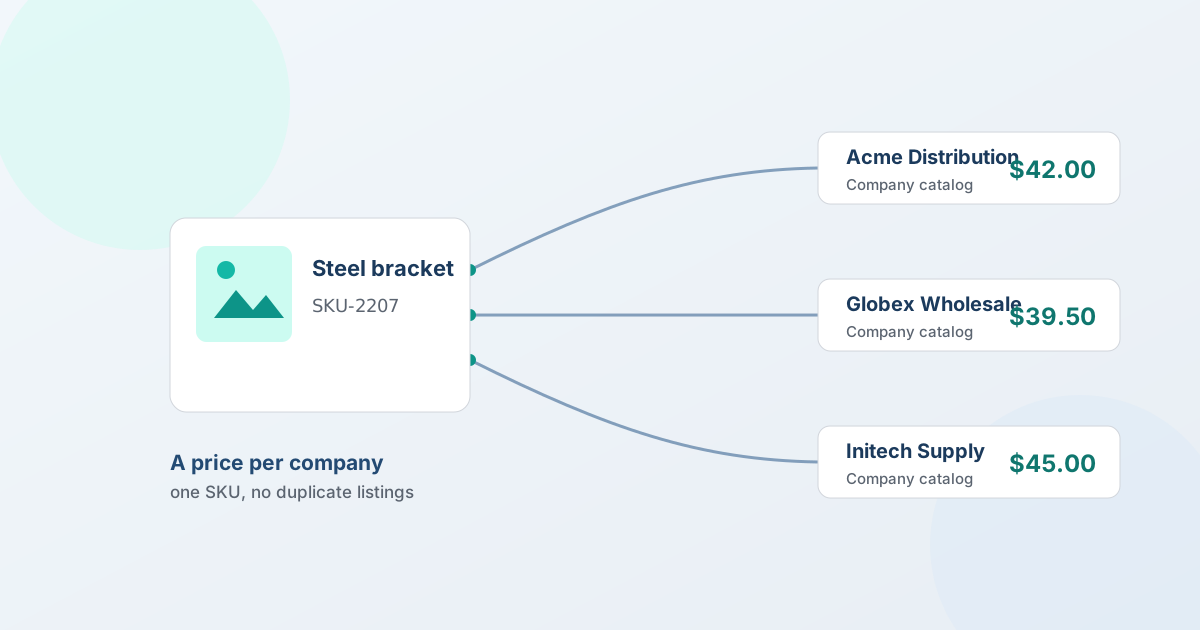
A Shopify B2B catalog is a company-specific price list: a catalog that reaches a company's locations - through a B2B market on any plan, or assigned directly on Shopify Plus - controls which products that buyer sees and the prices they pay, without duplicating any SKUs. This guide explains how catalogs, companies, locations, and price lists fit together, what catalogs do well, where they stop, and how quoting lets you negotiate from a buyer's catalog and handle off-catalog requests.
What is a Shopify B2B catalog?
A catalog in Shopify B2B is a pairing of a product selection and a price list, that reaches company locations through B2B markets on any plan, or by direct assignment to companies and locations on Shopify Plus. It does two jobs: it controls which products a B2B buyer can see and buy, and it sets the prices that buyer pays. Because the price lives in the catalog rather than on the product, one product can carry a different price for every company - no duplicate listings, no separate "wholesale" products, and no split inventory.
Companies, locations, catalogs, and price lists
Shopify B2B models a buyer's business the way it actually works:
- Company - the buying organization (the account).
- Company location - a branch, region, or ship-to address under that company; each location can have its own catalog, addresses, and payment terms.
- Catalog - the product selection plus the price list that applies to a location, through a B2B market or (on Plus) by direct assignment.
- Price list - the per-product prices (fixed prices or a percentage off) inside a catalog, along with volume and quantity rules.
A buyer logs in, Shopify recognizes their company and location, and shows them their catalog's products at their catalog's prices. If you sell the same goods to two distributors at different rates, each gets its own catalog on the same SKUs. For the single-product, two-price mechanics, see wholesale vs. retail pricing without duplicate SKUs.
What catalogs do well - and where they stop
Catalogs are the right tool for standing, published prices: the agreed rate a company pays day to day, applied automatically when they log in. They're clean, native to Shopify, and they keep your catalog and inventory intact. If a signed-in buyer sees the retail price instead, why B2B buyers can't see their prices checks the six conditions a catalog price depends on.
What a catalog doesn't do is negotiate. A catalog is a fixed answer, and a lot of B2B selling is a conversation:
- A buyer wants a one-off price on a large order that isn't in their standing list.
- They request items that aren't on their catalog at all.
- The deal needs a volume break, a custom discount, or sign-off before it's final.
- A new account needs a price before they're set up with a catalog.
For those, you need a quote - a priced proposal you can adjust, that both sides can counter, and that converts to a real order once it's agreed.
Quoting from a company catalog
This is where a quote app works with your catalogs rather than around them. With QuotWay, when a logged-in B2B company contact requests a quote, the proposal starts from that buyer's company-location catalog - their own prices, not generic retail - so you negotiate from the right baseline. Any line that isn't on the buyer's catalog is flagged in the proposal editor and again at conversion, and is hidden from that buyer's quote button, so you don't quote a product the company isn't entitled to. For the agency side of this - which catalog wins when a location has several, how volume pricing changes the starting price, and what a quote must record - see what price a Shopify B2B quote should start from.
When the quote is agreed, it converts to a native Shopify draft order with the negotiated prices and the buyer's payment terms. QuotWay reads your native Shopify catalogs and payment terms - it doesn't store its own price lists or act as a separate pricing system (the architecture behind that choice, for agencies and developers, is in what lives in Shopify and what belongs in the quote layer). You can also break your analytics out by company, to see how much pipeline each account represents. Company-aware quoting, catalog pricing, and per-company analytics are on the Enterprise plan with a B2B-capable store - see how company-aware B2B quoting fits your catalogs.
Do you need Shopify Plus for catalogs?
No, but the catalog rules differ by plan. Since Shopify's 2026 rollout, Basic, Grow, and Advanced stores with B2B enabled can use Companies and catalogs - with up to 3 active catalogs across all B2B markets. Assigning a catalog directly to a company or company location is a Shopify Plus feature, as is having an unlimited number of them; below Plus, catalogs attach to B2B markets instead. QuotWay detects your store's B2B capability automatically rather than checking for the Plus plan, and if your store doesn't run native B2B yet you can still quote wholesale buyers with tag- and segment-based targeting and hidden prices. The full plan-by-plan breakdown is in do you need Shopify Plus for B2B?; see also B2B on Shopify Plus and the pricing tiers.
Frequently asked questions
What is a Shopify B2B catalog?
A Shopify B2B catalog is a pairing of a product selection and a price list, assigned to B2B markets - or, on Shopify Plus, directly to individual companies and company locations. It controls which products a B2B buyer can see and the prices they pay - and because the price lives in the catalog rather than on the product, one product can carry a different price for every company, with no duplicate SKUs, no separate "wholesale" products, and no split inventory. Catalogs handle standing, published pricing; negotiating a one-off rate is where a quote app comes in.
How do price lists and catalogs work in Shopify B2B?
A catalog is a product selection (a publication) plus a price list, and it reaches company locations through a B2B market on any plan or by direct assignment on Plus. The price list applies a percentage adjustment or fixed prices per variant, and a fixed price overrides the percentage; quantity rules and volume pricing attach to the catalog. When a location can reach the same product through more than one catalog, the catalog assigned directly to the location is the most specific and wins, and among equals the lowest price shows - with quantity rules and volume pricing from the first catalog created if two tie on that price; off Plus, three active catalogs across all B2B markets is the limit. A quote layer reads the price Shopify resolves for the location as its starting point instead of keeping prices of its own.
How does QuotWay use my B2B company catalogs and price lists?
On the Enterprise plan with a B2B-capable store, a proposal starts from the buyer's company-location catalog (price list), so you negotiate from their own B2B prices rather than generic retail prices, and any line that isn't on the buyer's catalog is flagged - and hidden from that buyer's quote button. The buyer sees their company name, their company-location address, and any payment terms on the quote. QuotWay reads these from your native Shopify B2B catalogs rather than storing its own price lists.
Can I set different wholesale and retail prices without duplicating SKUs?
Yes. Use Shopify's native B2B catalogs and price lists to set company-specific prices on the same product - no duplicate SKUs and no split inventory. QuotWay works alongside them: it handles the deal-by-deal side, where a buyer requests a quote, you negotiate, and the agreed price converts to a Shopify draft order.
Do I need Shopify Plus to use QuotWay?
No. QuotWay works on standard Shopify stores. Company-aware quoting with Shopify's native B2B - Companies and catalogs - requires a B2B-capable store, but since Shopify's 2026 rollout those are no longer exclusive to Plus, so many non-Plus stores qualify. QuotWay detects your store's B2B capability automatically, and payment terms work on any quote without B2B.
The Shopify facts in this post are kept current in the Shopify B2B reference (Catalogs, quantity rules and volume pricing), re-verified at every Shopify Edition and quarterly API release.
Sources
The time-sensitive Shopify facts in this guide are verified against Shopify's official documentation:
Related articles
See how QuotWay handles this on your store.